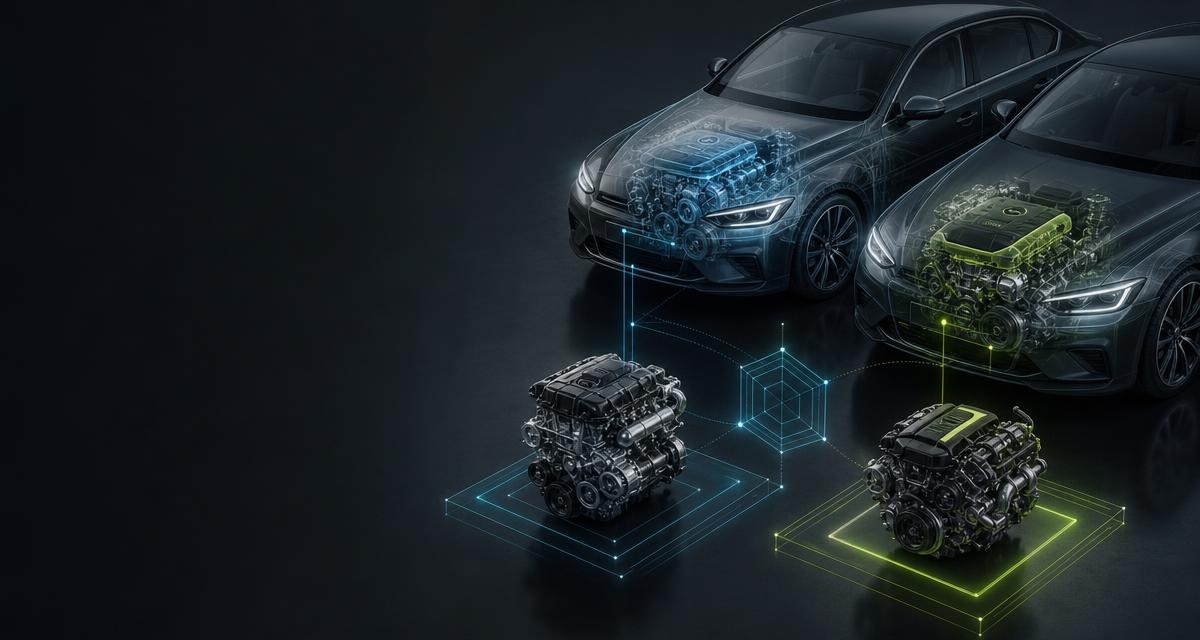
- Engine code
- The engine code is a manufacturer-specific identifier of the engine variant. It distinguishes engines that look identical by displacement and power but differ in management, charging, exhaust after-treatment and ancillaries.
Why displacement and power are not enough
A statement like „2.0 litres, 110 kW“ describes a class, not an engine. Within a model line several engine variants can share those headline figures and still differ in almost everything that matters for a spare part: injection system, timing chain or belt, turbocharger, exhaust gas recirculation, layout of the ancillaries.
For used-part trading that is the difference between a sale and a return. A listing that gives only displacement and power invites a wrong order — and the wrong order is charged to the seller.
Where the code sits
- On the engine block, stamped or on a label. The location differs by manufacturer and is often awkward to reach.
- On the vehicle data sticker — the label with the vehicle codes, often in the service book, the spare wheel well or the boot floor.
- In the vehicle papers, differing by country and issue date; in the German registration certificate it is not a standard field — see The registration certificate: the fields that matter in the yard.
- In manufacturer data via vehicle identification, that is via the VIN.
How the code is built
There is no uniform format. Combinations of three or four letters are common, sometimes with digits, sometimes tied to a model designation. Some manufacturers carry the engine code as part of a longer technical identifier, others as a code of its own.
Little can be derived from the code itself without manufacturer data — it is a key, not a speaking name. What stands behind it comes from the data source, not from the character string.
What the code is needed for
| Use | Why the engine code is needed |
|---|---|
| Selling a complete engine | The buyer narrows the engine variant by code; fitment still needs further attributes |
| Assigning ancillaries | Turbocharger, injection pump, intake manifold and control unit differ per variant |
| Sourcing spare parts | Catalogues ask for the engine code on many positions |
| Analysing stock | Only with the code can you say which engine variants actually sell |
In the listing
An engine listing without a code is skipped by buyers who want certainty. The recommended combination: engine code, model line and build period, the OE number of the engine or its ancillaries, plus the donor vehicle's VIN. That lets the buyer verify fitment themselves — and that is exactly what reduces enquiries.
Operating case: sell an engine without variant roulette
User story: As a trader or dismantler, I want to list a complete engine without a similar-sounding powertrain becoming a fitment promise. Engine code, evidence photo, OE numbers, production period, gearbox code, donor VIN, mileage, test status and included ancillaries are therefore separate fields.
| Step | Data or response | Benefit |
|---|---|---|
| Vehicle context | GET /vin/{vin}/vehicle returns data such as display name, production date, vehicle-type keys and equipment depending on source | The search starts with a concrete vehicle, not displacement and kW alone |
| Secure the engine code | Code from data sticker, engine block or a reliable manufacturer source plus photo | A missing code remains visible instead of being guessed |
| Cross-check parts | GET /parts/oe/{oeNumber} adds available part name, maker, fitments and supersession chain | Engine and ancillaries receive checkable references |
| Release | Engine code, OE references, build period and scope are checked together | Fewer wrong orders and fewer expensive return shipments |
Measure it: Track listings with evidenced engine code, pre-sale questions, cancellations for a variant mismatch, compatibility returns and return-freight cost. On engines and gearboxes, one prevented mismatch makes the value of disciplined data visible.
Sources and legal references
Frequently asked
Where do I find the engine code fastest?
On the vehicle data sticker with the vehicle codes. Depending on the manufacturer it sits in the service book, the spare wheel well or the boot floor.
Is the engine code in the registration document?
In the German registration certificate it is not a standard field. That document holds displacement, power and fuel type, not the engine variant.
Are displacement and power enough?
For a rough classification yes, for fitment no. Several engine variants can share those figures and still need different parts.
Can I derive the engine code from the VIN?
Not from the character string itself. A vehicle identification can look up the engine data where the data source holds it.