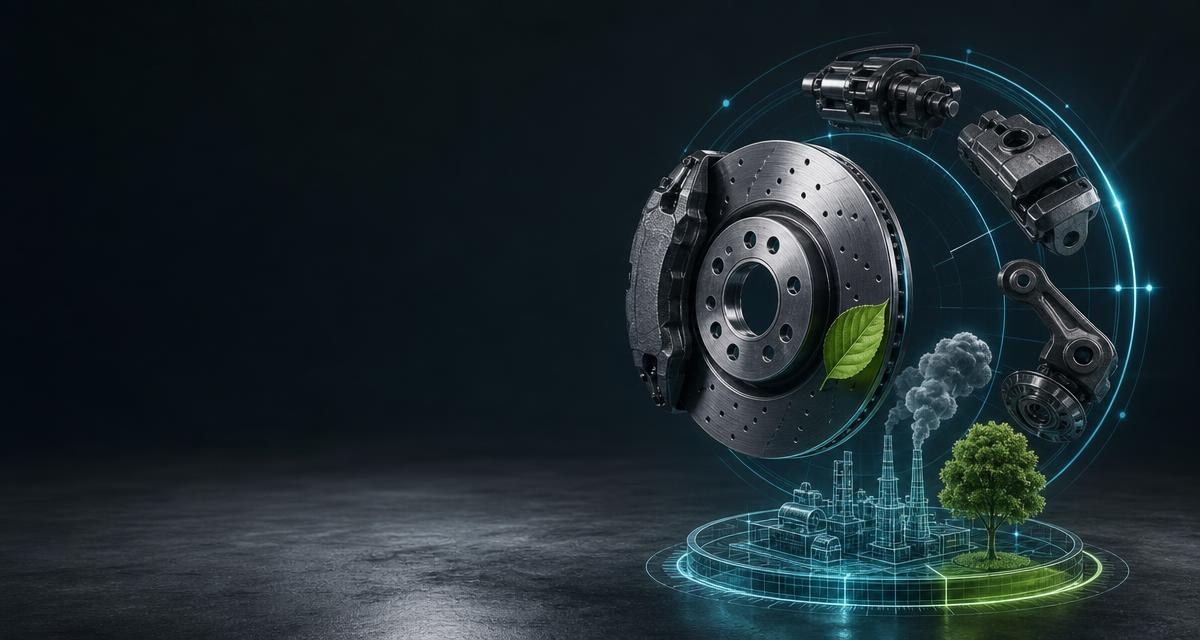
The environmental advantage of a used part is not a marketing invention but a simple balance: a part that already exists does not have to be made again. The emissions of raw material extraction, processing, manufacture and transport of a new part fall away. What remains is dismantling, preparation, storage and shipping — small by comparison.
Where a new part's emissions arise
| Stage | Contribution |
|---|---|
| Raw material extraction | Ore, bauxite, crude oil for plastics — for metals the most energy-intensive step |
| Material production | Smelting and alloying; primary aluminium is markedly more energy-intensive than steel |
| Manufacture | Forming, casting, machining, coating, painting |
| Transport | Supply chain, often across several countries |
| Use and disposal | Usually small for a spare part |
The lion's share sits in the first three stages. Those are exactly the ones a used part avoids entirely — it has already been made.
Why we do not quote a blanket percentage
Neat figures for the CO₂ saving of used parts circulate in sales material. They are not necessarily wrong, but they rest on assumptions that are rarely supplied: which part, which material, which production route, which electricity mix, which transport distance, which system boundary?
A figure without that is not a measurement but an estimate dressed as one. We therefore do not quote a saving we cannot support with a disclosed calculation basis. What can be said dependably: avoided manufacture is the dominant effect, and it is largest for metallic and complex components.
Which parts have the biggest lever
- Aluminium and cast parts. Material production dominates the balance; reuse avoids it completely.
- Electronic assemblies. Control units contain semiconductors and printed boards whose production is very intensive relative to weight.
- Large body and bolt-on parts. Much material, much forming, plus paint.
- Powertrain components. Engines, gearboxes and axle parts combine high mass with elaborate machining.
Notably this overlaps with the commercial view: they are largely the same parts that earn the most — see Depth of dismantling: which parts are worth removing.
Why this increasingly matters commercially
Fleet operators, leasing companies and larger workshop chains increasingly report on the environmental effects of their procurement. They therefore no longer ask only about price and availability but about dependable data. A dismantler who documents a part's origin and reference cleanly can answer that question — one who does not drops out of the tender.
The European reform of end-of-life vehicle law points the same way: more reuse, more recycled content, more evidence. Assessment in EU ELV Regulation 2026/1738: timeline and impact on businesses.
What a business can concretely do
- Document every part's origin via the VIN — that is the basis of any later statement.
- Keep weight and material in the record; both are inputs to any balance calculation.
- In communication, explain the mechanism instead of asserting a figure: „this part was not newly manufactured.“ That is true, checkable and strong enough.
- If a figure is demanded, supply the calculation basis with it — or say clearly that no dependable one exists.
Sources and legal references
Frequently asked
How much CO₂ does a used part save?
It depends on the part, the material and the production route. A blanket figure without a disclosed calculation basis is an estimate, not a measurement. The dominant effect is always avoided manufacture.
Is recycling not just as good?
No. Recycling recovers the material but the component is made anew. Reuse avoids manufacture altogether, which is why it ranks above recovery in the waste hierarchy.
Does a sold used part count towards the recovery quota?
Yes, as reuse — and towards both quotas. See Recovery quotas: understanding the 95 and 85 per cent targets.
Can you issue me a CO₂ certificate?
We do not issue a certificate for which we lack the calculation basis. What we can supply are the evidenced attributes of the part — weight, material, origin — from which a balance can be calculated transparently.
This article is general professional guidance and does not replace legal advice. The applicable statute and the conditions imposed by your competent authority prevail.