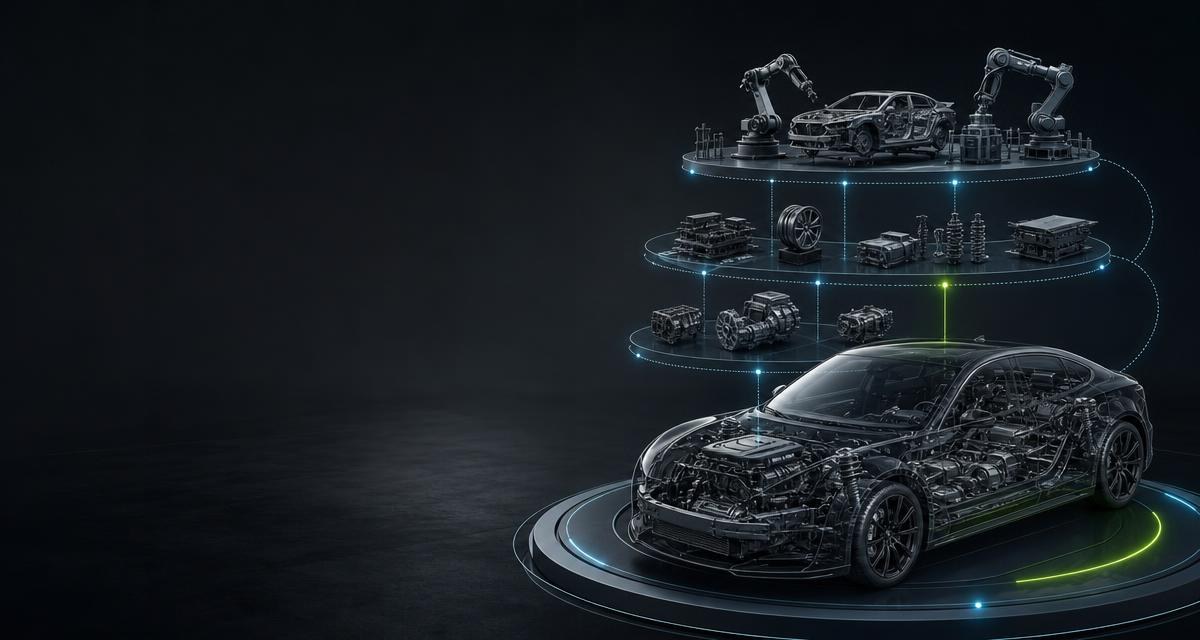
- OEM — Original Equipment Manufacturer
- The OEM is the vehicle manufacturer: the company that places the finished vehicle on the market and answers for it under its own brand. Volkswagen, BMW, Stellantis, Renault, Toyota — those are OEMs.
Why the term keeps being mixed up
People say „an OEM part“ and mean an original part. Taken literally that is off: the OEM is the manufacturer, not the part. The confusion has a cause — in other industries OEM denotes the contract manufacturer, in automotive it denotes the customer. Working with international suppliers, it is worth asking which side is meant.
More useful in practice is the position in the chain: who specifies the part, who builds it, and who sells it to the end customer?
| Role | Short | Task |
|---|---|---|
| Vehicle manufacturer | OEM | Specifies the part, issues the OE number, holds the type approval |
| Original equipment supplier | OES | Develops and builds the part on the OEM's behalf |
| Parts trade and independent workshop | IAM | Distributes spare parts outside the franchised network |
| Dismantler | — | Recovers original parts from end-of-life vehicles |
Who actually builds the parts
Vehicle manufacturers build less of their vehicles themselves than many assume. Brakes, lighting, control units, air conditioning, seats, turbochargers, injection systems — much of it comes from specialised suppliers and carries the supplier's brand and number alongside the OE number.
That is why a removed part often carries two numbers: the vehicle manufacturer's part number and the supplier's article number. For stock keeping that is an advantage — both are search terms buyers actually use. For untrained capture it is a source of error, because the more prominent number is usually the supplier's.
What „original-equipment quality“ means
A part in original-equipment quality matches the specification with which the part was fitted at the factory. It need not carry the vehicle maker's brand for that: the same supplier that feeds the production line may also offer the part under its own name in the free market.
This is not a loophole but deliberate policy. The block exemption regulation for the motor vehicle sector secures the free market's access to spare parts and technical information. Its practical core: a repair at an independent workshop using matching-quality parts must not by itself cost the manufacturer's warranty. What that means for the parts market is covered in IAM: the independent aftermarket and where dismantlers sit in it.
And the used part?
A genuine part removed from a vehicle is original equipment by definition — it was the original equipment. No replica, no retrofit, no question of matching the specification. It is the strongest sales argument in the trade and is stated surprisingly rarely in listings.
- Fitment: original geometry, original connector, original mounting — no adapters.
- Availability: for older model lines the used part is often the only source, because new supply has ended.
- Price: clearly below the franchised dealer's price for a new part.
- Footprint: no new component, no new production — see CO₂ and used parts: what can honestly be said.
All of which requires the part to be findable. A genuine part sitting on a shelf without an OE number, without a vehicle reference and without a photo has every one of these advantages — and nobody hears about it. How a removed part becomes a findable record is covered in Part identification: from removed component to sellable record and Selling used parts online: what a listing has to carry.
OEM data in daily work
The vehicle makers' catalogue data is the most precise source for fitment questions — and the hardest to reach. It lives in manufacturer-specific systems, in differing formats, partly under licence. The free market therefore works with standardised data models such as TecDoc: the data model behind the independent aftermarket, which describe vehicles, parts and applications across brands.
Frequently asked
Is an OEM part better than a supplier part?
Not necessarily. Often it is the same part from the same line, differently packaged and printed. Differences arise where the supplier offers a deviating version for the free market.
Do I lose the manufacturer's warranty by having a used part fitted?
A repair outside the franchised network using matching-quality parts must not automatically cost the warranty. In an individual case it depends on the damage and its connection to the fitted part; the manufacturer's warranty terms govern.
What is the difference between OEM and OES?
The OEM is the vehicle manufacturer, the OES the supplier producing for it. In many cases the physical part comes from the OES, while the number and the responsibility come from the OEM.
Why does my part carry two different numbers?
Because it was built by the supplier and is listed by the vehicle manufacturer under its own number. Capture both — buyers search with both.