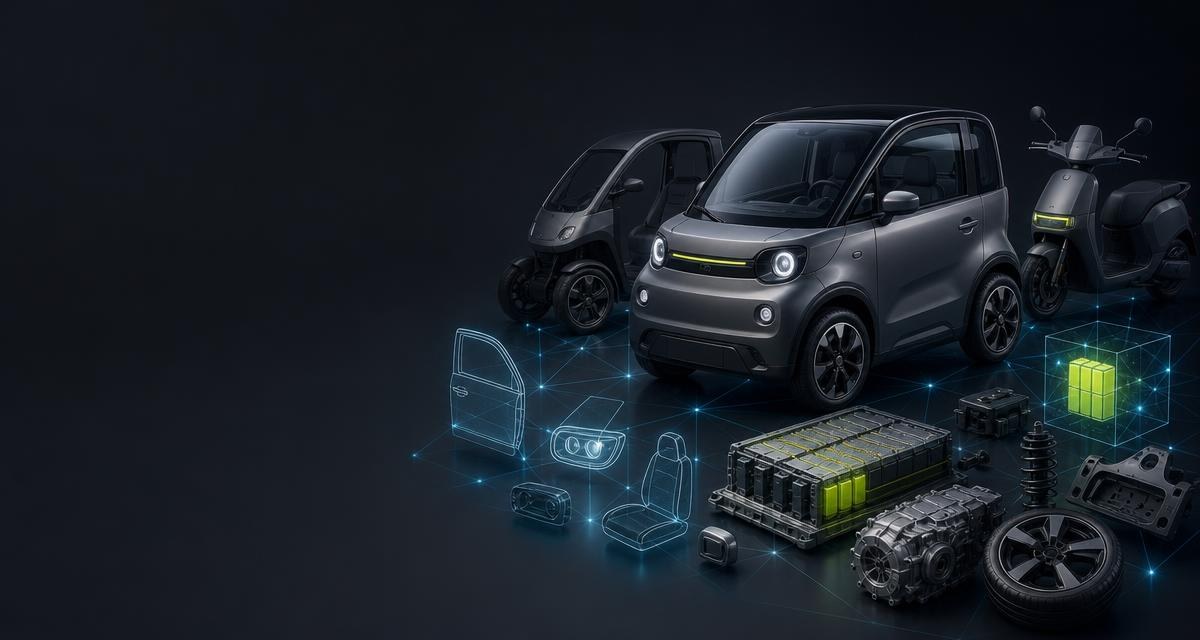
Vehicles such as Opel Rocks, Citroën Ami and Fiat Topolino are commonly called microcars. Their legal vehicle class is what matters operationally. Many are light quadricycles in class L6e. This classification determines type approval, driving licence and technical limits, and therefore how businesses should record vehicles and parts.
Microcar is a market term; L6e is the legal class
- EU Regulation 168/2013 generally limits L6e vehicles to a maximum design speed of 45 km/h.
- The common enclosed L6e-B subcategory is limited to 425 kg mass in running order and 6 kW maximum continuous rated or net power.
- Passenger variants in this subcategory provide no more than two seating positions including the driver.
- L6e is not the M1 passenger-car class, so catalogues, ERP systems and marketplaces should store the class explicitly.
Germany's AM licence from age 15
In Germany, licence category AM includes light quadricycles in class L6e and has a minimum age of 15. Holders who have not yet reached 16 may use it only within Germany under the German Driving Licence Regulation. Calling it a scooter licence is colloquial; category AM is the legally precise term.
Why this may become a lasting trend
- Earlier access: young people can use enclosed individual transport with an AM licence.
- Compact dimensions: small vehicles use less road and parking space than conventional cars and fit space-efficient urban mobility concepts.
- Electric urban use: limited speed and range suit short, predictable journeys in and around cities.
- Weather protection: enclosed models offer more everyday weather protection than a scooter or moped.
- Emerging used fleet: a growing fleet later creates demand for repair data, used components and economical battery assessment.
Opel Rocks as a practical example
Opel states a 45 km/h top speed, 6 kW continuous output, up to 75 kilometres of WMTC range and around four hours of charging from a household socket for the Rocks. The manufacturer also describes use from age 15 with category AM. These values illustrate the typical profile: short journeys, simple charging and deliberately limited performance.
What parts traders and recyclers should prepare for
- Dedicated vehicle and part classifications instead of treating every unit as either a car or a two-wheeler.
- Strong relevance of body panels, glazing, lamps, charging equipment, control units and model-specific interior parts.
- Documented checks of traction battery, 12-volt system and charging equipment before reuse or recycling.
- Clear compatibility data because visually related group models do not automatically use identical parts.
- Shipping and dangerous-goods processes that handle electrical components and batteries separately.
How tapinomahub can represent this market
- Capture VIN, type-approval data and vehicle class in structured fields so L6e does not become an imprecise car record.
- Match OE numbers and visible labels from images against the vehicle context.
- Transfer condition and image data consistently into stock records and listings.
- Supply ERP, shop and sales channels with the same vehicle and part identity through an API.
- Store battery and inspection attributes as traceable data points rather than free text only.
Sources and legal references
Frequently asked
Can a 15-year-old drive an Opel Rocks in Germany?
Yes, with a category AM driving licence. Until the holder reaches 16, § 10 FeV limits use to Germany.
Is an L6e microcar legally a passenger car?
No. It belongs to European class L6e rather than passenger-car class M1 and follows its own technical and licensing framework.
Why do microcars matter to vehicle recyclers?
A growing fleet creates demand for used body, electrical, charging and interior parts as well as documented battery assessment.
Are parts from related microcar models automatically compatible?
No. Compatibility should be checked through OE number, variant, production period and vehicle data even when models look closely related.