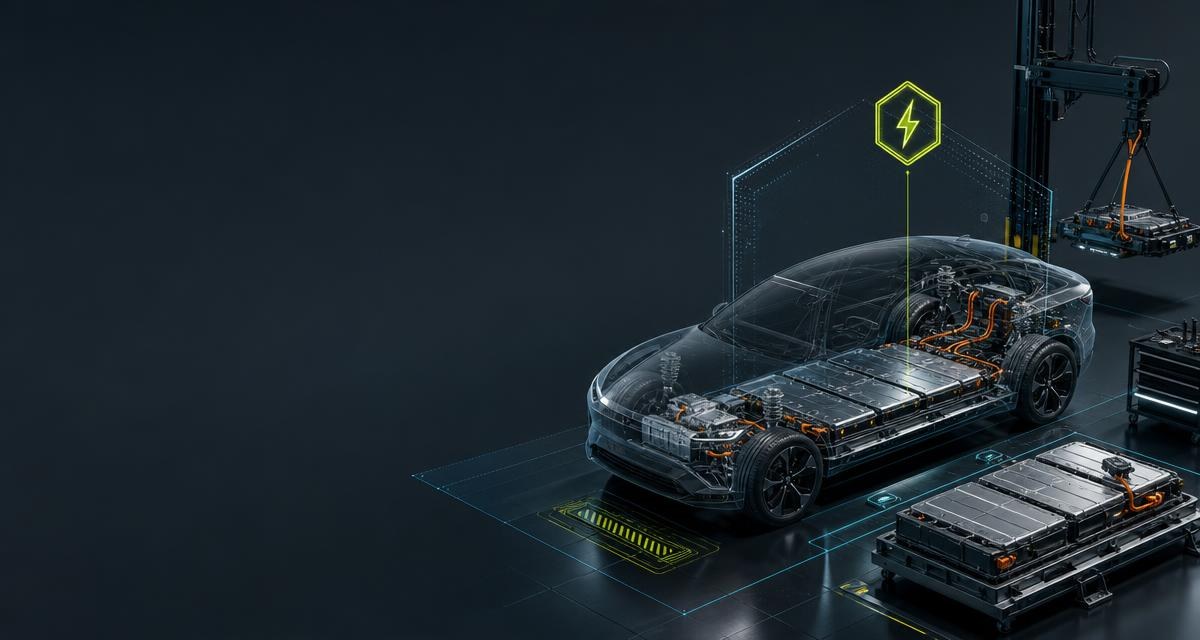
The first large cohorts of fully electric vehicles are reaching the end of their first life. For dismantlers that means a new vehicle type in the yard, with a component that has no predecessor — the high-voltage battery. It is at once the most valuable and the most delicate part of the vehicle.
What is different about a high-voltage system
- It is live, even at standstill. Unlike a combustion car, an electric vehicle cannot be made dead by disconnecting the 12-volt battery. The traction battery stays charged.
- The energy is stored chemically. It cannot be drained like fuel. A damaged cell can heat up with a delay.
- The marking is unambiguous. Orange cabling, warning symbols and disconnect points are standardised and should be located before any intervention.
- The weight distribution differs. Battery packs weigh several hundred kilograms and sit in the floor; lifting points and equipment must suit.
Competence is a precondition, not a nicety
Work on vehicles with high-voltage systems carries graded competence requirements: from awareness for work that does not touch the system, through the ability to de-energise it, to work on live parts. Which level applies to which activity follows from the applicable rules and the requirements of your employers' liability insurance association.
In practice: whoever only moves and inspects the vehicle needs an instruction. Whoever isolates the high-voltage system or removes the battery needs demonstrable competence. Those records belong in the same file as the yard's other qualification records — they are asked for in a review, see Authorised treatment facility: requirements and periodic review.
Intake and storage
- Establish the condition. Accident vehicle or undamaged? Visible deformation around the battery pack is a different case from a failed drive motor.
- Treat damaged batteries separately. They belong in a dedicated, monitored area with adequate distance to other vehicles and buildings.
- Consider the state of charge. Manufacturer requirements and dangerous-goods rules govern storage and transport.
- Plan fire protection. Extinguishing media, access and distances are to be agreed with the fire service and the insurer before the first vehicle arrives.
- Document. Vehicle, condition, storage location and time belong in the vehicle file as with any other end-of-life vehicle.
The battery: reuse, second life, recycling
| Route | Precondition | Note |
|---|---|---|
| Reuse in a vehicle | Battery functional, condition evidenced | The most valuable route — needs a dependable state statement |
| Second life outside the vehicle | Sufficient remaining capacity, suitable buyer | For instance as stationary storage; requires preparation |
| Material recycling | Handover to a permitted recycler | Recovery of the contained metals |
All three routes presuppose the same datum: the condition of the battery. It cannot be estimated and cannot be seen. Stating a remaining capacity you have not measured means selling a claim — and on a component of this magnitude that is not a small matter.
What is moving legally
Batteries are subject to their own European law beyond end-of-life vehicle rules: requirements on collection, recycling efficiency, recovery rates for individual metals and information duties up to a digital battery passport for larger batteries. For dismantlers that mainly means one thing: the battery gets its own documentation trail alongside the vehicle file.
The precise state of the requirements and the deadlines should be checked before operational decisions; the rulebook is younger than most of the procedures it attaches to.
What else is interesting on an electric vehicle
Over the battery it is easy to overlook that an electric vehicle has a complete remainder: body, chassis, interior, glazing, wheels, on-board charger, heat pump, drive unit, power electronics. Much of it is in higher demand than on a comparable combustion car, because the new part is expensive and the model line is young. On deciding what is worth removing, see Depth of dismantling: which parts are worth removing.
Operating case: damaged EV at intake
A non-running electric vehicle arrives after underbody damage. The business does not decide immediately on removal or sale; it separates identification, safety assessment and economic assessment into three documented approvals.
| Stage | Data and check | Decision |
|---|---|---|
| Triage | Visible damage, temperature anomalies, warnings, transport state and safe parking location | Quarantine, monitoring or normal intake area |
| Identification | VIN record, manufacturer rescue data, labels, OE numbers and physical match | Correct work instruction and qualified person |
| Condition | Manufacturer-compliant diagnostics, insulation and fault data, documented SoH where available and mechanical condition | Reuse, qualified second-life route or recycling |
GET /vin/{vin}/vehicle establishes vehicle context; GET /vin/{vin}/parts and GET /parts/oe/{oeNumber} can add available parts and reference data. Identity and OE context reach the ERP without duplicate entry. The qualified specialist combines them with rescue information, manufacturer procedures, diagnostics and physical findings.
Tangible value: the business avoids duplicate vehicle and part-number maintenance, routes unresolved vehicles into a safe exception process early and offers saleable components with traceable origin. Measure triage before work, unresolved battery identities, qualified-person approvals, complete condition evidence and time to disposition.
Sources and legal references
Frequently asked
May any employee move an electric vehicle?
For activities that do not touch the high-voltage system an instruction is usually enough. Interventions in the system require demonstrable qualification; which one follows from the applicable rules and your insurance association's requirements.
How do I store a damaged high-voltage battery?
Separately, monitored, with adequate distance and agreed fire protection. The specific requirements are to be clarified with the fire service, the insurer and the competent authority.
Can I sell a traction battery as a used part?
In principle yes, provided condition and function can be evidenced and transport and product requirements are met. An estimated remaining capacity is not evidence.
Does the battery count towards the recovery quota?
Batteries are subject to their own battery-law requirements alongside end-of-life vehicle law. How that affects reporting in detail is to be clarified with the competent authority.