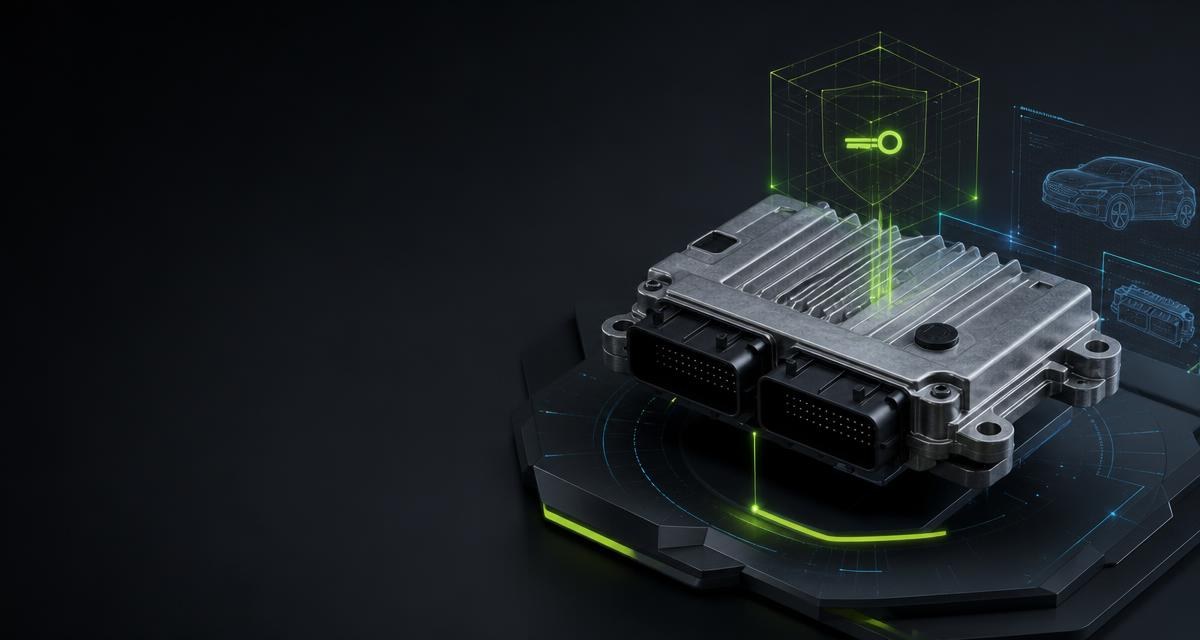
A control unit is a small box with high value, low weight and little wear. For used-part trading that would be the ideal combination — were it not that some of these units have to be adapted to the vehicle after fitting. Leave that out of the listing and you sell once and take one back.
Why a control unit does not simply fit
Modern vehicles treat their control units not as interchangeable components but as participants in a network. Three mechanisms stand in the way of a straight swap:
- Theft protection. Powertrain and access control units are tied to the immobiliser. A foreign unit is not accepted by the vehicle until it has been adapted.
- Variant coding. The same unit serves several equipment variants. Which functions are active sits in the coding, not in the hardware.
- Software level. Control units carry software that must match the rest of the vehicle. A unit from an older or newer car can be hardware-identical and still not run.
Four categories worth keeping apart
| Category | What the buyer must do | Typical units |
|---|---|---|
| Direct swap | Fit and done | Many comfort and operating modules without vehicle binding |
| Coding | Set the variant in the vehicle, diagnostic tool needed | Modules serving several equipment levels |
| Adaptation | Match with the immobiliser or key | Engine management, access systems |
| Not transferable | Unit stays bound to its original vehicle | Individual systems with fixed vehicle binding |
Which category applies depends on manufacturer, model line and build year — and changes within a model line. There is no blanket statement about „control units“.
What belongs in the listing
- The [[oe-nummer|OE number]] and the hardware or software level exactly as printed on the unit. Both matter for fitment and both usually sit on the same label.
- The donor vehicle's [[vin|VIN]]. On control units it is more than provenance: it lets the buyer check the equipment variant.
- The note about coding or adaptation, clearly and before purchase.
- A sharp image of the label. It is evidence and source for number capture at the same time — see Image recognition in the yard: reading type plates and part numbers.
Capture in the yard
Control units are small, look alike and lose their assignment faster than any other component. A box on a shelf without a vehicle reference is practically unsellable, because the variant can no longer be determined.
- Photograph the mounting position before removal.
- Photograph the label with numbers and software level before it gets dirty.
- Label the unit immediately — with a number pointing to the vehicle file.
- Read the numbers from the images and fill the record, see Part identification: from removed component to sellable record.
A word on liability
Describing the adaptation requirement in the listing moves the agreed quality onto what is actually delivered: a working unit that needs setting up. Concealing it means selling a unit that „does not work“, with the corresponding consequences. Basics in Liability for defects on used parts: what applies and what does not.
Frequently asked
Does every used control unit need coding?
No. Some modules can be swapped directly, others must be coded or adapted to the immobiliser. Which category applies depends on manufacturer, model line and build year.
Can a control unit be permanently bound to one vehicle?
For individual systems, yes. Such units cannot be transferred to another vehicle; that belongs explicitly in the listing.
Which numbers belong in the listing?
The vehicle manufacturer's part number and, where present, hardware and software level from the label, plus the donor vehicle's VIN.
How do I avoid returns on electronics?
With a clear note before purchase, a sharp image of the label and the donor vehicle's VIN. That lets the buyer check rather than hope.