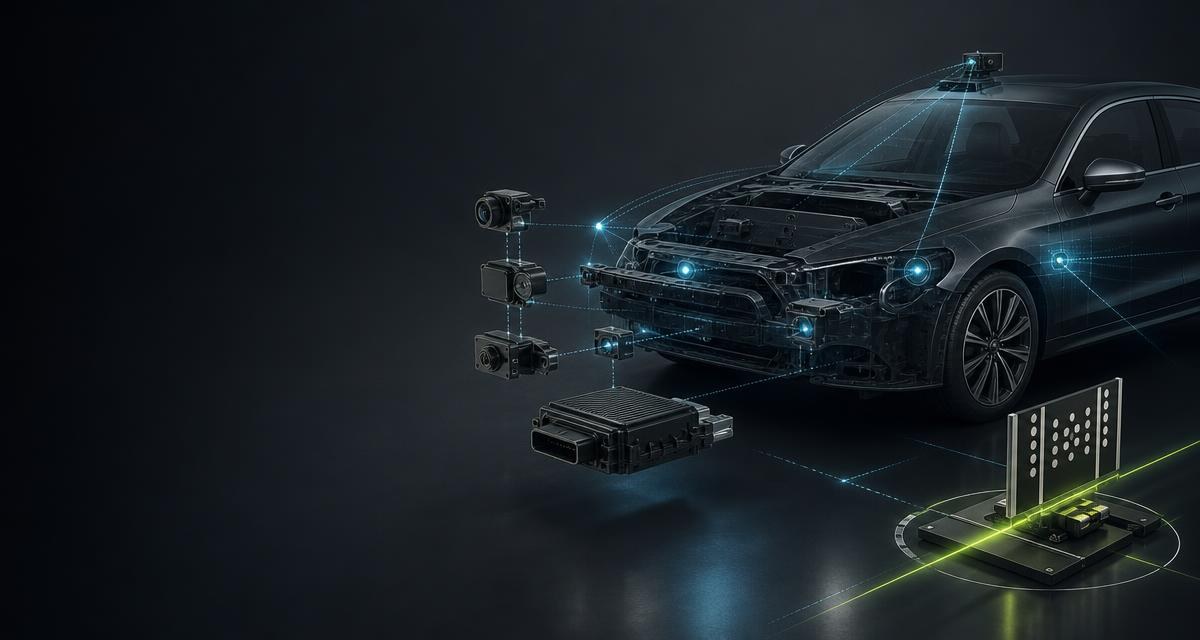
A front radar from a three-year-old mid-size car is one of the most valuable single items on the shelf — and one of the trickiest. It looks undamaged, works on the bench and is still worthless if nobody knows which version it came from and whether it can be calibrated after fitting. This text separates the three questions that sales routinely blur: what is it, does it work, and may it be fitted like that?
Why the stock keeps growing
Regulation (EU) 2019/2144 makes a series of assistance systems mandatory equipment for vehicles of categories M, N and O. The obligations arrive in stages: first for new types, then for all new vehicles — the advanced driver distraction warning, for example, for all new vehicles from 7 July 2026. What is fitted in series today reaches recycling within a few years. Radar sensors, front cameras, surround sensors and their control units therefore move from special case to standard stock.
The three questions, kept apart
| Question | Who answers it | With what |
|---|---|---|
| What is it? | The recycler | Confirmed OE number, manufacturer, hardware and software level, vehicle type of origin |
| Is it externally undamaged? | The recycler | Visual inspection with criteria, photos of housing, connector, bracket and lens |
| Does it work in the vehicle? | The workshop | Fitting, teaching-in, calibration per manufacturer specification, fault memory |
| May it be fitted like that? | Workshop and keeper | Vehicle variant, software level, coding, type-approval law where relevant |
Removal and description in practice
- Document before removal. Photograph fitting position, bracket, connector layout and the surrounding condition; a sensor without its bracket is a different product.
- Remove without impact. Radar and camera units are shock-sensitive; a drop onto the workshop floor is often invisible from outside.
- Read the label in full. Part number, hardware and software level belong in the listing — two sensors with the same OE number can carry different software levels.
- State the origin. Vehicle type, year and equipment variant of the donor vehicle; for accident vehicles, the damaged area.
- Name the limits. One sentence in the listing: the external condition was inspected, function and calibration take place on the vehicle at a specialist workshop.
Where tapinomahub helps
Identity is half the job here: POST /scanner/label/extract-all reads part number and version levels from the label, GET /parts/oe/normalize and GET /parts/oe/{oeNumber} confirm the number and supply vehicle assignment and replacement chain, GET /vin/{vin}/vehicle evidences type and equipment of the donor vehicle, and GET /recalls/vehicles/{vin} shows recalls, which matter particularly for assistance systems. For the images the usual route applies — From part photo to listing: the image route through the tapinomahub API.
Limits and liability
- Visual inspection is not a functional test. A sensor with internal damage looks unremarkable; that belongs in the item description.
- Software levels are part of the identity. The same OE number does not mean the same level; coding in the target vehicle matters too — Used control units: coding, immobiliser, listing.
- No assurance of road safety. A parts seller cannot assure suitability in the target vehicle; responsibility lies with fitting and inspection.
- Mind warranty. Statements in a listing are quality specifications — the narrower they are, the sounder the transaction; see Liability for defects on used parts: what applies and what does not.
A good ADAS listing therefore does not sell a function but an identified, externally inspected component with evidenced origin — and says in one sentence what the workshop still has to do. That honesty costs no margin and saves the most expensive kind of return.
Sources and legal references
Frequently asked
May I sell a radar sensor as functional?
Only if you actually tested the function and can say how. Otherwise describe the external condition and point out that function and calibration happen on the vehicle.
Why is the OE number alone not enough?
Because hardware and software level co-determine usability. Both are usually on the label and belong in the listing.
Is calibration always required after fitting?
The vehicle manufacturer specifies that. For surround sensors a calibration after removal or fitting is the rule, and it happens on the vehicle.
Are ADAS parts safety parts?
They act on safety-relevant functions. Treat them like safety parts in your process: no automatic approval, always a human check.