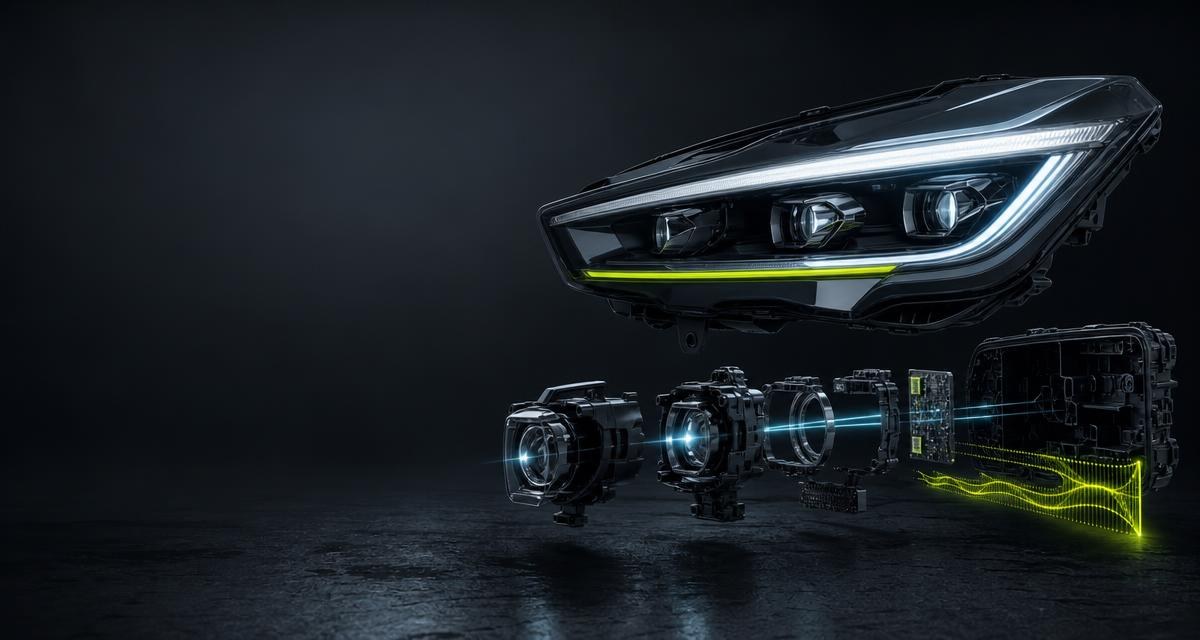
A headlamp is an expensive new part, a frequent accident casualty and therefore a classic of used-part selling. It is also the component where two outwardly identical units can be technically entirely different — and the buyer notices only when the connector does not fit or the light does not come on.
The variants that look almost the same
| Attribute | Why it matters |
|---|---|
| Light source | Halogen, xenon or LED — different reflector, different electronics, different connector |
| Ballast | On gas-discharge systems, inside the lamp or mounted separately |
| Levelling | Manual or automatic, with actuator and sensors |
| Cornering light | Additional actuators in the housing |
| Daytime running light | Present or not, different control |
| Left- or right-hand traffic | Different cut-off line |
| Side | Driver or passenger side, in the direction of travel |
All seven rows matter for fitment. That is why the model alone — „headlamp left, Golf“ — is not a usable description. What is needed is the OE number and a statement of the variant.
The marking on the housing
Every headlamp carries a marking: the vehicle manufacturer's part number, the lamp maker's number and an approval mark with an approval number. The latter says which approval the lamp conforms to — not which vehicle it fits. For context see Type approval, general approval and expert reports: what each paper means.
Condition: what you see and what you do not
- Lens. Clouding, yellowing, scratches, stone chips — on plastic lenses the most common defect. Photograph it, do not describe it.
- Housing and mounting tabs. Broken tabs cause most headlamp returns. Check and name every one.
- Seal. A leak shows as misting or a water line inside.
- Connector pattern. Photograph it; it is the fastest way to tell variants apart.
- Function. If you cannot test, write „not tested“. On gas-discharge and LED systems a functional test without a vehicle is laborious — saying so openly beats asserting it.
Singly or as a pair
A pair from the same vehicle with matching ageing achieves more than two single sales — the lenses age together, and a car with one clear and one clouded headlamp looks worse than one with two even ones. A single sale pays where exactly one lamp is to be replaced; then the lens condition is the key attribute, because it has to sit beside the existing one.
Caution with refurbishment
Polished or recoated lenses look better, and refurbishment is a business of its own. For the listing the same rule applies as everywhere: what was altered must be named. A refurbished headlamp is a refurbished headlamp — not an as-new one. Lifting the condition through the wording sells an expectation the part does not meet.
Frequently asked
Why does my headlamp not fit although the model is right?
Because several variants exist within one model — halogen, xenon, LED, with or without cornering light, with different levelling. The OE number governs, not the model.
Where do I find the number on a headlamp?
Usually on the back of the housing, moulded or printed, together with the lamp maker's number and the approval mark.
Do I have to test the function?
Where possible, yes. Where not, „not tested“ belongs in the listing. An asserted function that does not hold up costs more than an open statement.
Is selling as a pair worth it?
Usually yes, because the lenses have aged evenly and a car with two matching headlamps looks better than with one new and one clouded.