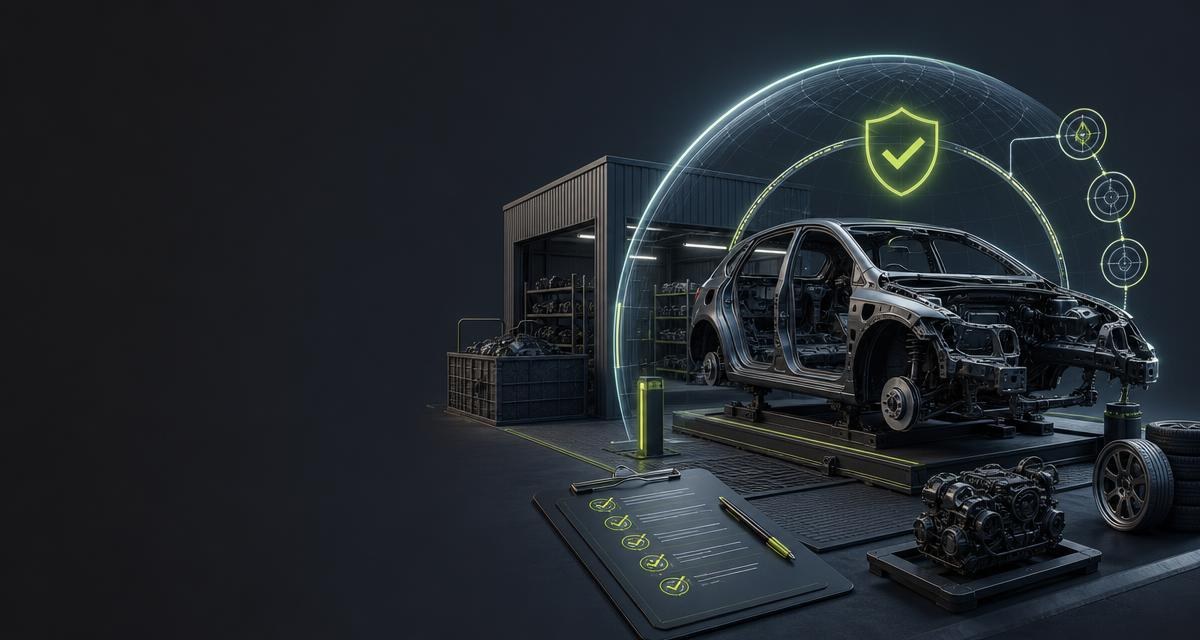
- Authorised treatment facility
- An authorised treatment facility is a business officially confirmed as entitled to accept, depollute and dismantle end-of-life vehicles under the end-of-life vehicle rules. Only it may issue the certificate of destruction.
Why authorisation exists
An end-of-life vehicle contains fuel, oil, coolant, brake fluid, refrigerant, a battery and pyrotechnic components. Dismantling it improperly creates soil and water contamination that cannot be undone. Authorisation is the filter that ensures surfaces, equipment and procedures exist before the first vehicle is accepted.
It is at the same time what distinguishes a treatment facility from a scrapyard — externally, towards authorities and, increasingly, towards customers who want to know where a used part comes from.
Structural requirements
The requirements start at the surface a vehicle stands on, before and after depollution:
- Sealed, liquid-tight surfaces for intake, depollution and the storage of vehicles that have not yet been depolluted, with collection facilities and separators.
- Separate storage areas for depolluted and non-depolluted vehicles, so that untreated vehicles cannot slip unnoticed into further dismantling.
- Weather-protected storage for components carrying operating fluids, in particular oily parts.
- Suitable containers for waste oil, fuels, coolant and brake fluid, batteries, filters and oil-bearing consumables — separated and labelled.
- Equipment for extracting operating fluids and for neutralising pyrotechnic components.
Depending on plant size and location, further permits apply — under emission control, water and building law. Which of them bite depends on the individual case and must be clarified with the competent authority.
Organisational requirements
Equipment alone is not enough. The review also asks whether the business commands its processes and can evidence them:
- Responsibilities and qualification. Who depollutes, who issues certificates, who answers for the waste streams — and how those people are trained.
- Operating records. Intake, depollution, part removal, hulk transfer and waste transfer must be traceable per vehicle.
- Quantity capture and reporting. The quantities needed for quota reporting must arise from day-to-day operation rather than being estimated at year end.
- Evidence of disposal routes. For every waste stream it must be documented who received it and that the recipient is permitted to take it.
The recurring review
Authorisation is a procedure, not a state. The business is reviewed at recurring intervals by an approved expert or a recognised supervisory organisation and submits the certificate to the competent authority. Surfaces, equipment, procedures and documentation are examined — in practice above all the documentation, because it is the easiest to verify.
Exact intervals, the choice of reviewing body and the scope of the review follow from applicable law and the conditions of your authorisation. They should be agreed with the competent authority before the first review.
Where businesses fail the review
- Gaps in the vehicle file. Vehicles in the yard for which no intake record can be found.
- Non-depolluted vehicles in the wrong area. The most common structural finding.
- Missing evidence of where waste streams went. Especially for small quantities that go „along with“ something else.
- Certificates of destruction with incomplete entries. Usually a missing signature or a mis-transcribed VIN.
- Quantity reports built on estimates. They rarely survive the question of where the figures come from.
Authorisation and specialist waste management certification
Authorisation under end-of-life vehicle law and certification as a specialist waste management company are two different things that overlap in practice. Many businesses hold both, because the certification eases waste-law obligations and is a recognised quality signal towards clients.
Do not confuse dismantler recognition with Efb certification
| Evidence | What is examined | What the system should retrieve |
|---|---|---|
| Recognised dismantling facility | Facility and treatment under the German ELV ordinance, including operating log, depollution, dismantling and material flows | Vehicle receipts, certificates of destruction, treatment steps, quantities, recipients and incidents |
| Certified waste management company | Activities, sites and waste types stated in the certificate under KrWG and EfbV | Certificate scope, responsible persons, permits, training, registers and consignment evidence |
Both forms of evidence may apply to one company, but they are not interchangeable. Efb certification has a defined scope and is subject to recurring, generally annual review. Recognition as a dismantling facility follows the ELV ordinance and its operational requirements.
Operating case: the on-site audit sample
The expert selects one vehicle from the previous month. Instead of searching folders, management opens one vehicle record linking the intake document, verified VIN, receipt date, depollution, removed parts, material quantities, recipients and final shell destination in chronological order.
- Intake: POST /scanner/registration-document can extract registration data into structured fields; an employee verifies the result.
- Vehicle context: GET /vin/{vin}/vehicle links the VIN to technical data and a stable tapiId where the enabled source supplies it.
- Operating record: The ERP or operating log adds legally relevant treatment steps, quantities, evidence, approvals and recipients.
- Audit view: The business presents the complete timeline without treating an API response itself as legal evidence.
Operational KPIs: vehicle records complete before the next stage, correction rate for extracted document data, unresolved quantity or recipient assignments, missing competence evidence and time needed to produce an audit sample.
Sources and legal references
Frequently asked
May I accept end-of-life vehicles without authorisation?
No. Accepting end-of-life vehicles and issuing certificates of destruction are reserved to authorised facilities.
How often is a treatment facility reviewed?
At recurring intervals by an approved expert or a recognised supervisory organisation. The specific intervals follow from applicable law and your authorisation.
Do I additionally need specialist waste management certification?
It is not mandatory but is widespread in practice. It eases waste-law obligations and serves as recognised evidence towards clients.
What does authorisation cost?
Costs comprise the expert review, authority fees and the structural requirements, and depend heavily on the site. Reliable figures only come from a concrete quotation.
This article is general professional guidance and does not replace legal advice. The applicable statute and the conditions imposed by your competent authority prevail.