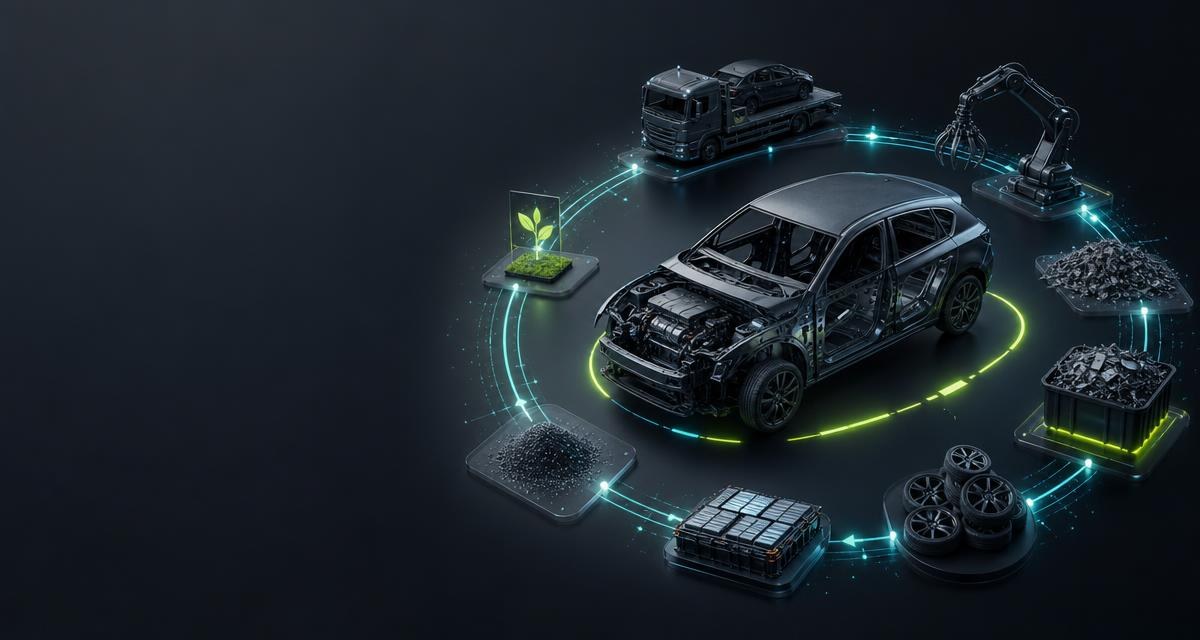
- Altfahrzeugverordnung (AltfahrzeugV)
- The German end-of-life vehicle ordinance governs the surrender, take-back and environmentally sound treatment of end-of-life vehicles. It transposes the European ELV Directive 2000/53/EC into national law and has applied since 2002.
What the ordinance regulates
It answers four questions that were answered inconsistently before it: who must hand over a spent vehicle, who may accept it, what must be removed before dismantling, and how much of the vehicle's weight must ultimately be reused or recovered.
It therefore addresses three parties at once: the last owner, the businesses in the treatment chain, and the vehicle manufacturers, who must maintain a nationwide take-back network.
Which vehicles it covers
It covers passenger cars and light commercial vehicles — categories M1 and N1 — plus three-wheeled motor vehicles other than motor tricycles. Heavy goods vehicles, buses and agricultural tractors are outside its scope and fall under general waste law.
The last owner's duties
Whoever parts with an end-of-life vehicle may not simply pass it on. It must be surrendered to an authorised collection point, a take-back point or an authorised treatment facility. In return the owner receives the certificate of destruction required by the registration authority for final deregistration.
Take-back is in principle free of charge for the last owner if the vehicle is complete — that is, essentially contains the components needed for operation, in particular powertrain, body, chassis, catalytic converter and electronics — and no waste has been added to it. If essential parts are missing or foreign waste has been added, a charge may be levied.
The dismantler's duties
The authorised treatment facility is where a vehicle turns into a waste stream and a parts range. The ordinance prescribes a fixed sequence:
- Intake and documentation. Identify the vehicle, check the papers, issue the certificate of destruction.
- Depollution. Remove operating fluids and hazardous components before any further treatment — described in detail in Depollution: what has to come out before dismantling.
- Dismantling for reuse. Remove and document components that can be recovered as spare parts.
- Material separation. Capture recyclables separately so that they can be recycled as material.
- Onward transfer. Hulk to a shredder, waste streams to permitted disposal operators.
- Records and reporting. Record quantities and report them to the responsible bodies.
Authorisation as a treatment facility is not a permanent state but is reviewed regularly. What is required is set out in Authorised treatment facility: requirements and periodic review.
The recovery quotas
The ordinance sets targets that relate to average vehicle weight and year, not to the individual vehicle: reuse and recovery of at least 95 per cent, of which reuse and material recycling at least 85 per cent. The detail — and the question of what counts towards which quota — is covered in Recovery quotas: understanding the 95 and 85 per cent targets.
Substance restrictions and marking
The underlying directive restricts the use of lead, mercury, cadmium and hexavalent chromium in vehicle materials, with a list of expressly permitted exemptions. For a dismantler this becomes practically relevant where mercury-containing components — typically in older vehicles — have to be removed before further treatment.
The directive additionally requires marking of components and materials to ease sorting during dismantling — for instance plastics markings from which the polymer type can be read.
What is currently changing
European end-of-life vehicle law is being revised: in 2023 the Commission proposed replacing the ELV directive and the type-approval recyclability directive with a single regulation. Its focal points include requirements for recycled content, greater weight on reuse and component recovery, and stricter rules against exporting non-roadworthy vehicles.
Until such a regulation applies, existing law continues to govern. What your business actually has to do follows the law in force and the conditions of your authorisation — check the current state of the legislative procedure before making operational decisions. An assessment of the proposal is in EU ELV Regulation 2026/1738: timeline and impact on businesses.
What this means for how a yard is organised
Every duty in the ordinance shares one property: it is subject to proof. It is not the act that counts but the documented act. A business that keeps intake, depollution, part removal and transfer in one continuous record passes an audit almost as a by-product — and has the same record as its selling basis.
Whoever instead captures the same facts three times — once in the record book, once in the ERP, once in the listing — pays for the ordinance three times over. How to bring that together is described in Digitalisation in vehicle dismantling: where it actually pays.
Operating case: vehicle intake as an auditable process
User story: As an authorised dismantler, I want to capture an end-of-life vehicle once and start a traceable chain for intake, certificate of destruction, depollution, parts harvesting and the shell. VIN and core data then need not be copied at every station.
| Station | Record | Benefit |
|---|---|---|
| Intake | Vehicle, presented papers, transferor and time; document extraction can prefill the record | Less duplicate entry |
| Identity check | Compare VIN from document, API response and vehicle | Catch mix-ups before issuing the certificate |
| Pretreatment | Removed substances, quantities, exceptions and responsible person | Gaps in required work become visible |
| Parts and shell | Reuse, material streams and transfers retain the vehicle link | The operating log and audits become easier to follow |
Measure it: Check record completeness before depollution, VIN corrections, quantities assigned later, missing transfer evidence and handling time per vehicle. These figures link compliance with faster throughput.
Sources and legal references
Frequently asked
Which vehicles does the ordinance cover?
Essentially passenger cars and light commercial vehicles of categories M1 and N1, plus three-wheeled motor vehicles other than motor tricycles. Heavy commercial vehicles and buses are outside its scope.
Is returning an end-of-life vehicle really free?
For the last owner, in principle yes, provided the vehicle is complete and no waste has been added. Where essential components are missing or foreign waste has been added, a charge may be levied.
Who may issue a certificate of destruction?
Authorised treatment facilities and, within the scope of their authorisation, collection and take-back points. A business without authorisation may not issue one.
May I resell parts from an end-of-life vehicle?
Yes. Reuse of components is expressly intended and counts towards the recovery quota. Individual safety-relevant components carry restrictions that must be checked case by case.
What happens if a vehicle disappears without a certificate?
Without a certificate of destruction, final deregistration cannot be properly documented. Duties remain with the owner, and the treatment chain lacks proof of proper handling.
This article is general professional guidance and does not replace legal advice. The applicable statute and the conditions imposed by your competent authority prevail.