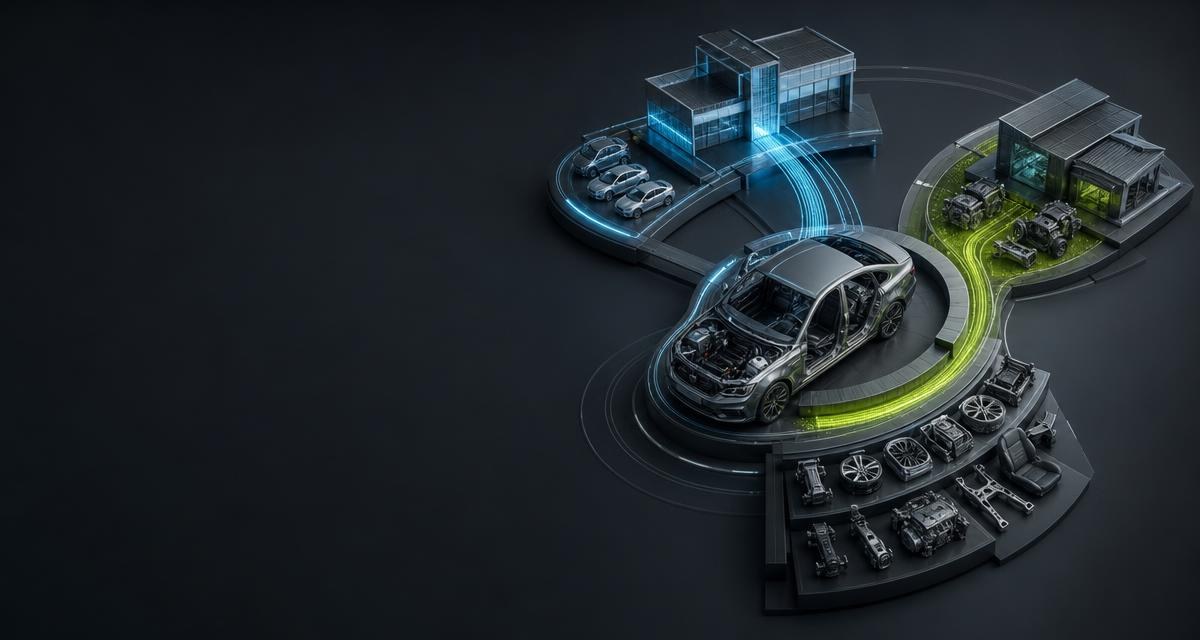
- IAM — Independent Aftermarket
- The IAM is the free spare-parts and service market outside the vehicle makers' franchised networks: parts wholesalers, independent workshops, online platforms — and dismantlers with used parts.
Who works in the free market
The IAM is not one industry but a chain with very different participants, all working on the same vehicle population in different roles:
- Parts makers and suppliers who also distribute their original-equipment programme independently.
- Wholesale and distribution, bundling the range and organising availability.
- Independent workshops performing maintenance and repair outside the franchised network.
- Online platforms and marketplaces, through which a growing share of parts sales now runs.
- Dismantlers recovering original parts from end-of-life vehicles and returning them to the market.
Why the free market exists in law
That a vehicle can be repaired outside the maker's network is no accident but the result of European competition policy. Two strands of regulation carry the market:
- The motor vehicle block exemption regulation. It limits how far manufacturers may close off their distribution and repair networks. Having a vehicle serviced by an independent workshop with matching-quality parts must not by itself cost the manufacturer's warranty.
- Access to repair and maintenance information. Manufacturers must make technical information and diagnostic data available to independent operators on a non-discriminatory basis. Without that access an independent workshop would be effectively unable to work on modern vehicles.
For dismantlers the second point is the more interesting one. The market is open — but access to the data you need in order to be visible in it has to be organised actively.
The dismantler as part of the IAM
A dismantler supplies something no other participant can: an original part at a used-part price. For discontinued model lines they are often the only remaining source. For body and bolt-on parts they undercut the new price many times over.
That structural advantage evaporates without data. The free market does not search for „black wing, fairly good“ but for an OE number, a vehicle assignment and an article type. Selling into the IAM means delivering in its language — and that language is data. See OE number: reading original part numbers correctly and GenArt number: what kind of part is this, actually?.
„Matching quality“ and the warranty question
Customers often ask whether a used part endangers their warranty. The honest answer is nuanced: a manufacturer's warranty is a voluntary commitment with its own conditions, while statutory liability for defects is law. A proper repair with a suitable part must not lead to a blanket loss of warranty; in a dispute what matters is the connection between the fitted part and the damage that occurred.
For the seller a practical rule follows: the more precisely a part is documented — OE number, donor vehicle, condition, images — the clearer it is in a dispute what was actually delivered. Documentation here is not paperwork but risk management. More in Liability for defects on used parts: what applies and what does not.
Where the market is heading
Three developments are shifting the weights in the free market, and all three favour dismantlers who have their data in order:
- Parts buying is moving online. What is not held as structured data does not appear in search.
- Repair over replacement is gaining political weight. Reuse is increasingly framed as an objective rather than a fallback — see EU ELV Regulation 2026/1738: timeline and impact on businesses.
- Vehicles are becoming data-intensive. Control units, coding and variants make fitment harder and reliable assignment more valuable.
The business that records every removed part cleanly today sells considerably more from the same yard tomorrow. That is a sales argument, not a technology argument. The route there is described in Digitalisation in vehicle dismantling: where it actually pays.
Frequently asked
What does IAM stand for?
Independent Aftermarket — the free spare-parts and service market alongside the vehicle makers' franchised networks.
Do used parts belong to the IAM?
Yes. Trade in used parts from end-of-life vehicles takes place entirely outside the franchised network and is therefore part of the free market.
May an independent workshop fit used parts?
Yes, provided the part is approved for the vehicle and technically suitable. Safety-relevant components carry additional requirements that must be checked case by case.
Why does a dismantler need parts data at all?
Because the free market searches by numbers. Without an OE number, a vehicle assignment and an article type a part appears in no search, however well preserved it is.