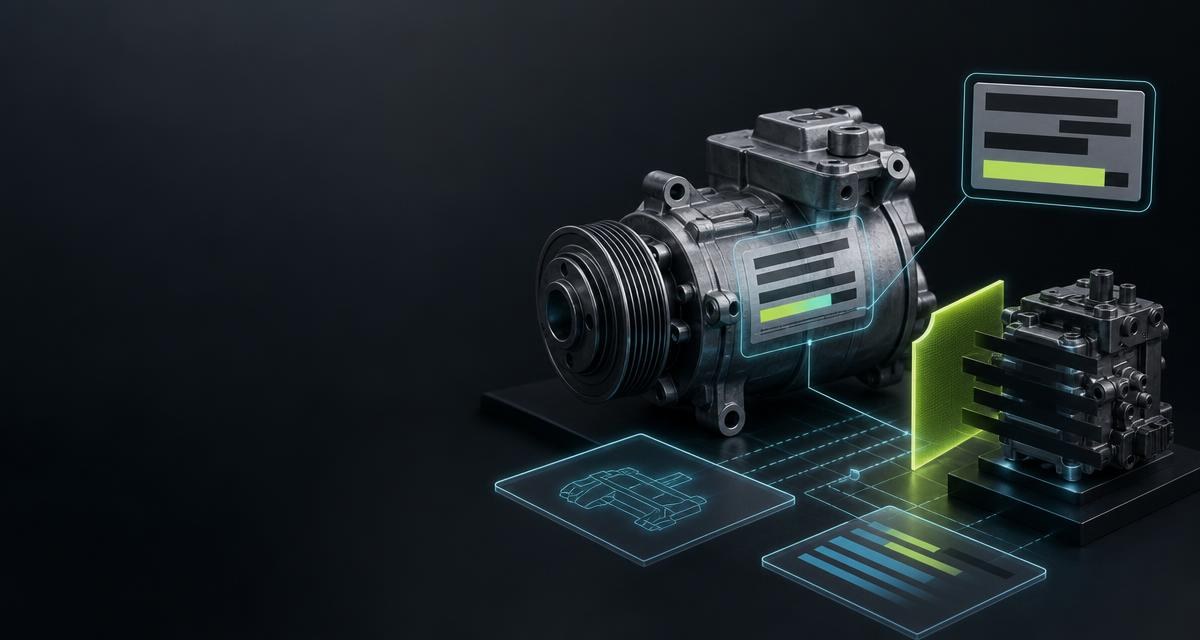
The identifier image is often the strongest evidence for a used part: it shows manufacturer, part number and revision. The same label may also contain a serial number, VIN, IMEI, MAC address, QR code or access key. Publication therefore needs more than general blur; it needs a distinction between type and instance.
Type identifier or instance identifier?
| Class | What it represents | Treatment in a public image |
|---|---|---|
| OE and manufacturer part number | Component type and version | Remains visible when safely classified as a type identifier |
| Hardware or software version | Version of the component type | Remains visible where it contains no instance-specific secret |
| Serial number | This individual component | Masked completely; only a safely classified type prefix may remain |
| VIN | This individual vehicle | Only the non-individualising beginning remains; the rest is masked |
| QR, Data Matrix or barcode | May encode type, instance or access data | The complete code area is disabled |
The distinction matters commercially. Without an OE number, the listing drops out of part-number search. With an open serial number, the seller publishes more than part identification requires. Correct processing preserves the search key and removes the instance key.
Fixed rules instead of invented replacements
- MAC address: keep the manufacturer prefix and replace the last three octets with
XX:XX:XX. - IMEI: keep the first eight digits and replace the last seven with
XXXXXXX. - VIN: keep the first nine characters and replace the last eight with
XXXXXXXX. - Serial number: mask fully with
X; only a safely classified type prefix may remain visible. - UUID, ICCID, EID, licence and access keys: mask completely.
- QR, Data Matrix and barcodes: make the code area unusable; never insert a newly valid fictional code.
The safe publication workflow
- Inspect the original. Locate text, number sequences and code areas and classify them by type or instance reference.
- Apply the rule. Mask only the defined areas; original values belong in neither response nor diagnostics.
- Scan the result again. Check the edited file once more for legible instance identifiers and valid codes.
- Do not publish when uncertain. If an identifier cannot be separated safely from a type identifier or fully disabled, the image remains blocked.
- Disclose the edit. The result remains an original photo of the part but carries a notice that identifiers were anonymised.
POST /vision/identifiers/redact implements this workflow for up to ten part images. The result is not a synthetic part image: the protected identifier areas are changed, not the object's geometry, condition or version.
What is better solved before processing
- Take two images. A public identifier image and a private detail reduce the conflict between selling and records.
- Do not photograph access data. A licence key absent from the image does not need later protection.
- Do not overwrite the original. Where the approved process permits storage, keep it separate from the publication image and apply the defined retention and deletion rule.
- Build approval into the workflow. Export to a marketplace only after the verification succeeds, not after the first masking pass.
Anonymising is not extracting
Extraction puts an identifier into the record — see Image recognition in the yard: reading type plates and part numbers. Anonymisation keeps an instance identifier out of the published image. Both steps may use the same photograph but require separate results and separate access rights.
Frequently asked
Is the OE number hidden as well?
Not when it is safely identified as a pure type identifier. It remains visible for search and part assignment; instance-specific serial and access data are masked.
Why not replace a barcode with another one?
A newly valid code would pretend that a non-existent identifier was real. The original code area is therefore disabled rather than replaced by a fictional code.
Is the result AI-generated?
No. It remains the submitted original photograph with anonymised identifier areas. The edit must be disclosed, but it does not make the component a synthetic depiction.
What happens when classification is uncertain?
If an instance identifier cannot be separated safely from a type identifier or its removal cannot be confirmed, no publication image is returned.