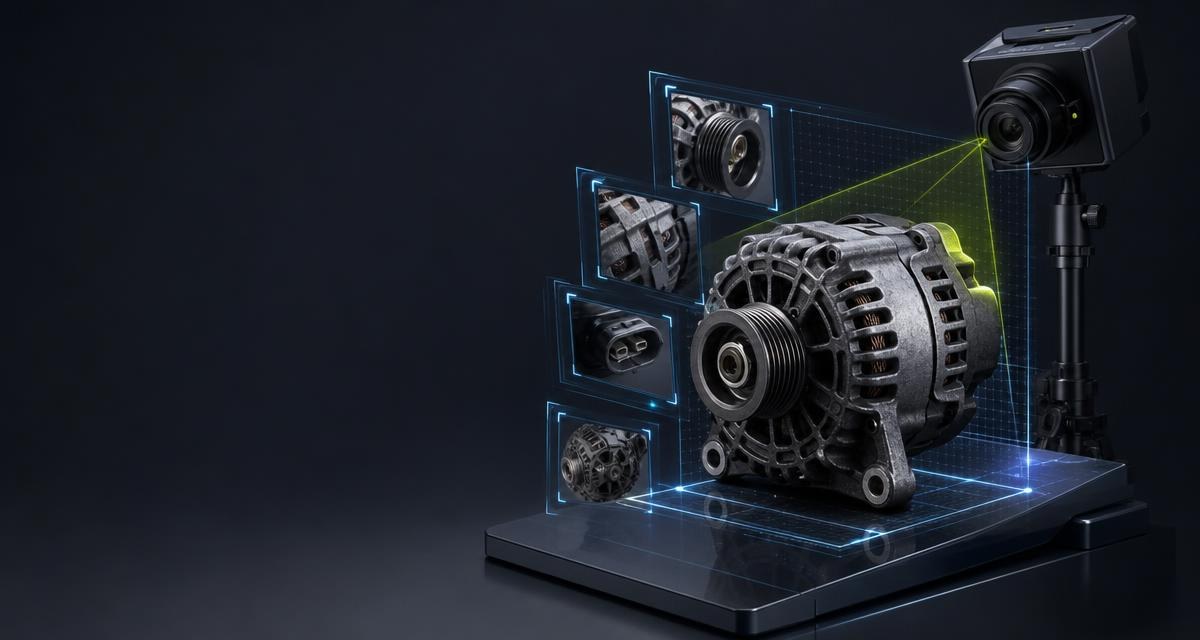
With a new part the customer buys a specification. With a used part they buy a single item they have never held. The images are the only thing that closes that gap. At the same price, a listing without an image is systematically bought later than one with — and returned more often.
The image sequence that works
- Overall view. The complete part, cut out or against a calm background, in the orientation the buyer knows.
- Identifier. Type plate, printing or stamping, large and sharp. This image is also the evidence for the number you state.
- Connectors and mountings. Plugs, flanges, threads, brackets — the places where variants differ.
- The defect. Scratch, crack, corrosion, missing tab. Show it and you sell more slowly but keep the money.
- Scale where needed. For parts without an obvious size, a folding rule helps more than any description.
Shooting in the workshop
- A fixed spot. A table with even background and light beats any retouching. Set it up once and save on every part.
- Diffuse light instead of flash. Flash creates reflections on painted and metallic surfaces and erases exactly the stampings that matter.
- Clean enough, not like new. Remove coarse dirt, but do not prepare the part so that the image suggests a better condition than it has.
- Always the same order. A fixed sequence makes images comparable and prevents forgotten shots.
Cutting out: the difference that counts
A cut-out image — the part without a distracting background — looks markedly more professional on marketplaces. There are two technical routes to it, and they are not equivalent:
| Method | What happens | Verdict |
|---|---|---|
| Determine the outline, keep the pixels | A model recognises the contour; composition happens in code. Every pixel of the part comes unchanged from your photo. | The right way |
| Have the image regenerated | An image model redraws the part against a new background. Edges look cleaner. | Not acceptable for customer material |
The second route looks better and is nonetheless wrong. A model that redraws a part knows neither the casting mark nor the type plate nor the exact geometry — it produces something similar. For an article the customer resells immediately, „similar“ is a false statement with the appearance of a photograph.
When there is no reference image
For new parts and for product groups without any usable photograph, a depiction can also be generated without a reference. That is an explicitly ordered mode and produces a depiction, not a photograph of the specific part. It has to be marked as such and must not appear as a photo of the individual item on offer.
A legal note in passing
Photos from other online shops or from manufacturer catalogues are other people's work. Using them in your own listing without permission is not allowed — however easy they are to find. For a single item your own photo is better anyway: the buyer wants to see this part, not another one.
Frequently asked
How many images does a listing need?
Three to five usually suffice: overall view, identifier, connectors and, where present, the defect.
Should I photograph defects?
Yes. A shown defect costs a few interested buyers; a concealed one costs the return and the review.
Is an AI cut-out image acceptable?
If only the background is removed and the pixels of the part come from your photo: yes. A redrawn part is no longer an image of your article.
May I use manufacturer photos?
Not without permission. And for a single item your own photo says more anyway.