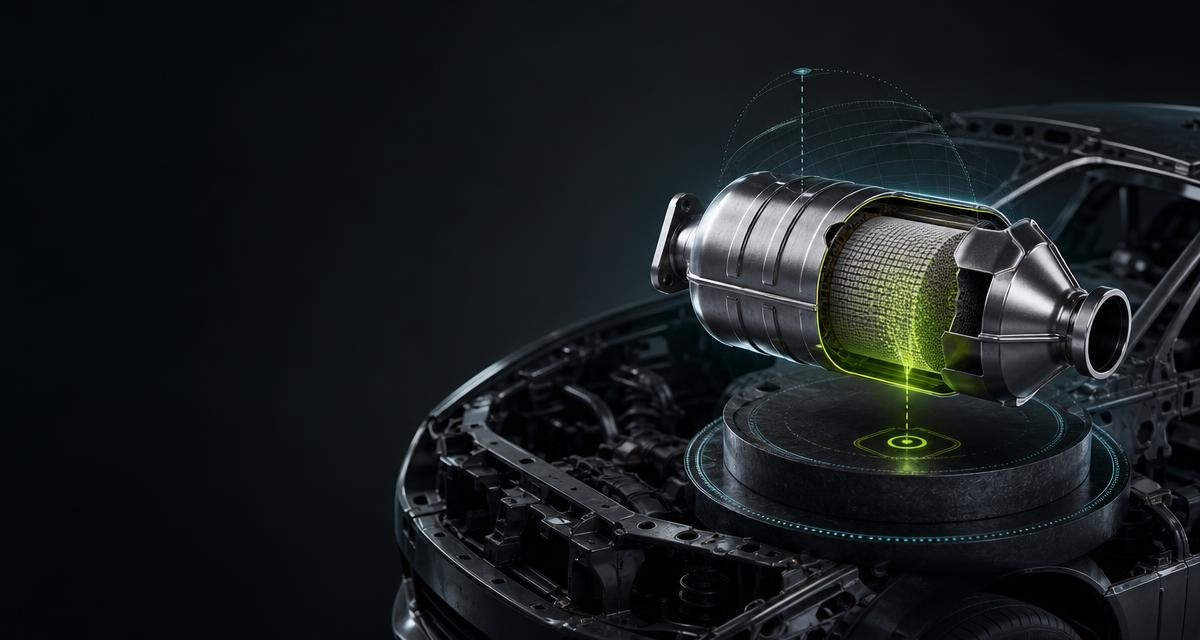
No other component of an end-of-life vehicle combines so much value with so little mass. The reason is the precious metals in the coating of the substrate: platinum, palladium and rhodium. They explain the price, the theft, and why a flat settlement by unit count almost always falls out against the dismantler.
How a converter is built
- Shell of stainless steel, usually with a stamped or welded-on marking.
- Substrate (monolith) of ceramic or metal with a honeycomb structure.
- Washcoat, a highly porous intermediate layer multiplying the effective surface.
- Precious metals finely distributed on the washcoat — this is where the value sits.
On diesel vehicles further components in the exhaust line can contain precious metal too, in particular the oxidation catalyst and the particulate filter. They are often overlooked in daily work because they are not called „catalytic converter“.
The marking on the shell
The shell usually carries a manufacturer marking, often together with a part number. That marking is the only dependable statement of which type it is — and therefore the basis of any valuation going beyond „converter, passenger car“.
How settlement works
Selling to a precious-metal recycler follows essentially two models:
| Model | How it works | When it fits |
|---|---|---|
| Flat, per unit or type | A fixed price from the buyer's experience | Small quantities, little effort, less transparency |
| Settlement by content | The substrate is milled, sampled and assayed; payment follows actual precious-metal content and market price | Larger quantities; requires traceable sampling |
Prices for platinum, palladium and rhodium fluctuate considerably and independently of one another. A price that was good last year says nothing about this year. Whoever sells flat should at least know which types they are handing over — otherwise the price cannot be compared with anything.
Recording and storage
- Record at removal. Vehicle via the VIN, marking from the shell, photo. Without those three, the converter is later a piece of metal on a shelf.
- Store separately. By vehicle type or converter type, not on one common heap — separation is the precondition for any differentiated settlement.
- Store securely. Value per cubic metre is higher than for almost anything else in the yard.
- Document the handover. Quantity, recipient, settlement model and outcome belong in the operating records — also for reporting, see Recovery quotas: understanding the 95 and 85 per cent targets.
The legal frame
The catalytic converter is among the components to be removed during depollution before further treatment. That is a requirement, not a commercial recommendation. It is commercially sensible anyway: a converter that goes into the shredder with the hulk is lost as a precious-metal source.
Reselling used converters as spare parts carries additional requirements from registration and emissions law that must be checked case by case. Sale for material recovery is unaffected by that.
From housing code to a negotiable individual item
A code can start a better valuation, but does not reveal exact precious-metal content. Variant, ageing, damage, contamination and a missing substrate change value. Reliable settlement links identity, photos, weight, condition, buyer catalogue or assay and final credit.
Operating case: capture at the removal station
- Create the instance: unique stock ID linked to donor vehicle, VIN, time and operator.
- Read the code: send a photo to POST /scanner/label/extract-partnumbers; confirm candidates on the component.
- Check OE context: GET /parts/oe/{oeNumber} can supply identity, reference family and name after a base match.
- Add market indication: GET /parts/oe/{oeNumber}/price can evaluate available offers, not metal content.
- Compare offers: retain quotes, deductions, assay method and final settlement on the same instance.
| Possible output | Not evidence of |
|---|---|
| Candidates from a readable image | Correct reading of dirty, corroded or ambiguous marks |
| OE and reference data after a match | Substrate, metal mass or tamper-free physical condition |
| Indicative market range | Live commodity quote, refinery result or guaranteed payout |
KPIs: individually identified converters, unresolved codes, quote-to-credit variance, proceeds per instance, capture time and stock variance.
Sources and legal references
Frequently asked
Why is a catalytic converter so valuable?
Because of the platinum, palladium and rhodium in the substrate coating. The quantities are small, the prices high and volatile.
Is individual recording really worth it?
For a component of this value density, almost always. Without a type marking, neither a price can be compared nor a settlement verified.
Do diesel particulate filters contain precious metal too?
Components in a diesel exhaust line can contain precious metal as well. They are frequently overlooked because they carry a different name.
May I sell a used converter as a spare part?
That carries additional requirements from registration and emissions law which must be checked case by case. Handover for material recovery is independent of it.