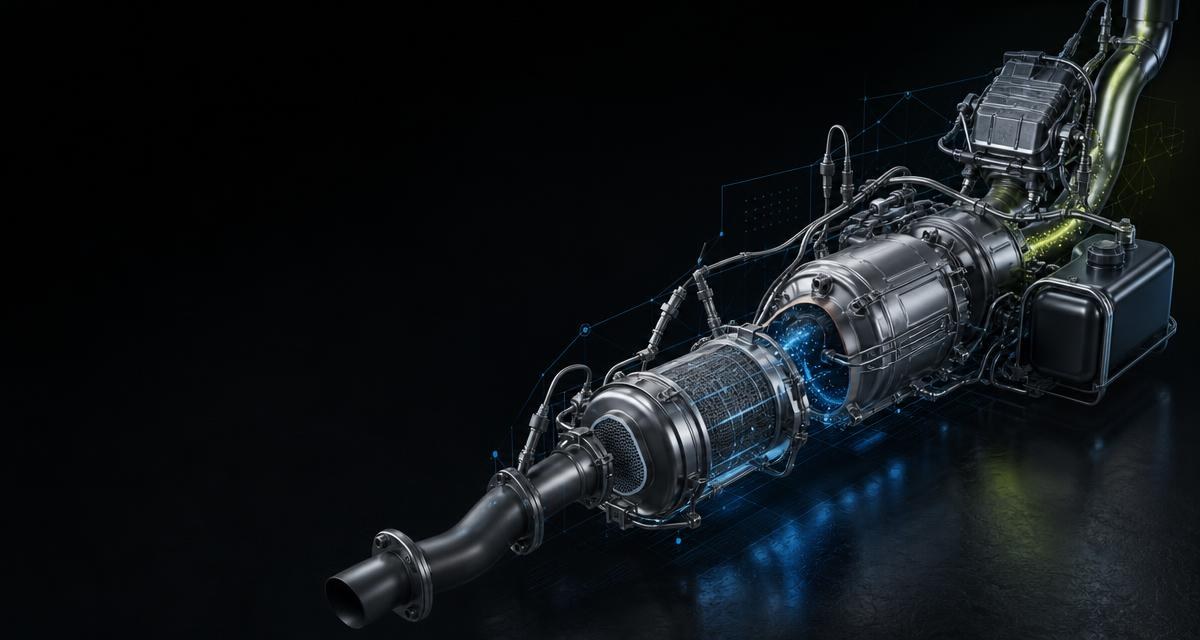
With every stage of the emission standard the exhaust line has grown longer and more expensive. What used to be a manifold, a converter and a silencer is now a chain of components with their own sensors, their own control and in part their own consumables. For used-part trading that is one of the most rewarding product groups — and one of the most in need of explanation.
The components and what they do
| Component | Function | Note for selling |
|---|---|---|
| Oxidation catalyst | Converts carbon monoxide and hydrocarbons | Contains precious metal, see Catalytic converters: why they belong in the record individually |
| Diesel particulate filter | Retains soot particles, regenerated periodically | Condition depends on loading and ash content |
| SCR catalyst | Reduces nitrogen oxides using a reducing agent | Works with a dosing unit and tank |
| Dosing unit and tank | Feed the reducing agent into the exhaust flow | Separate components with their own numbers |
| Sensors | Temperature, pressure, nitrogen oxide and lambda sensors | Small parts with a high new price |
| Exhaust gas recirculation | Returns part of the exhaust | Valve and cooler are positions of their own |
Every row is an article of its own with its own OE number — and that is where money is left on the table in practice: remove and sell the exhaust line as „exhaust system“ and you sell five articles for the price of one.
What can be checked on a removed component
- External visual check. Perforation, impact marks, cracked flanges, missing bolts.
- Look into the channel. On a particulate filter, damaged channels and excessive deposits become visible.
- Compare weight. A filter heavily loaded with ash is noticeably heavier than a lightly loaded one — an indicator, not a measurement.
- Check sensor ports. Broken threads for probes devalue the component.
- Donor vehicle mileage. On particulate filters the most important indicator of all.
Why these components are in demand
Three reasons converge: the franchised dealer's new price is high, a failure regularly takes the vehicle off the road, and the vehicle's value often no longer justifies repair with a new part. The used-part trade works exactly in that gap — and the buyer is usually a workshop with a waiting customer, see Workshops as customers: what a trade buyer needs differently.
What belongs in the listing
- OE number and vehicle reference, because the components differ by engine variant within a model line.
- Engine code of the donor vehicle — on exhaust components almost as important as the part number, see Engine code: the identifier that separates engine variants.
- Mileage and the result of the visual inspection.
- Completeness: which sensors are included, which are not? They are individually expensive and the most common point of dispute.
- A note on adaptation where the component hangs off a control unit, see Used control units: coding, immobiliser, listing.
- Images of the connections and of the marking on the housing.
Frequently asked
Can I sell a used particulate filter?
Yes. Dependable statements are donor vehicle mileage, visual findings and weight — not a remaining capacity nobody measured.
Why are exhaust components so sought after?
Because the new price is high, a failure takes the vehicle off the road, and repair with a new part is often uneconomic on older vehicles.
Are the sensors included?
Only if you write it. Probes and sensors are individually expensive and the most common point of dispute in this product group.
What do I do with unusable exhaust components?
They contain precious metal and belong in the corresponding recovery stream, not in ordinary metal scrap.