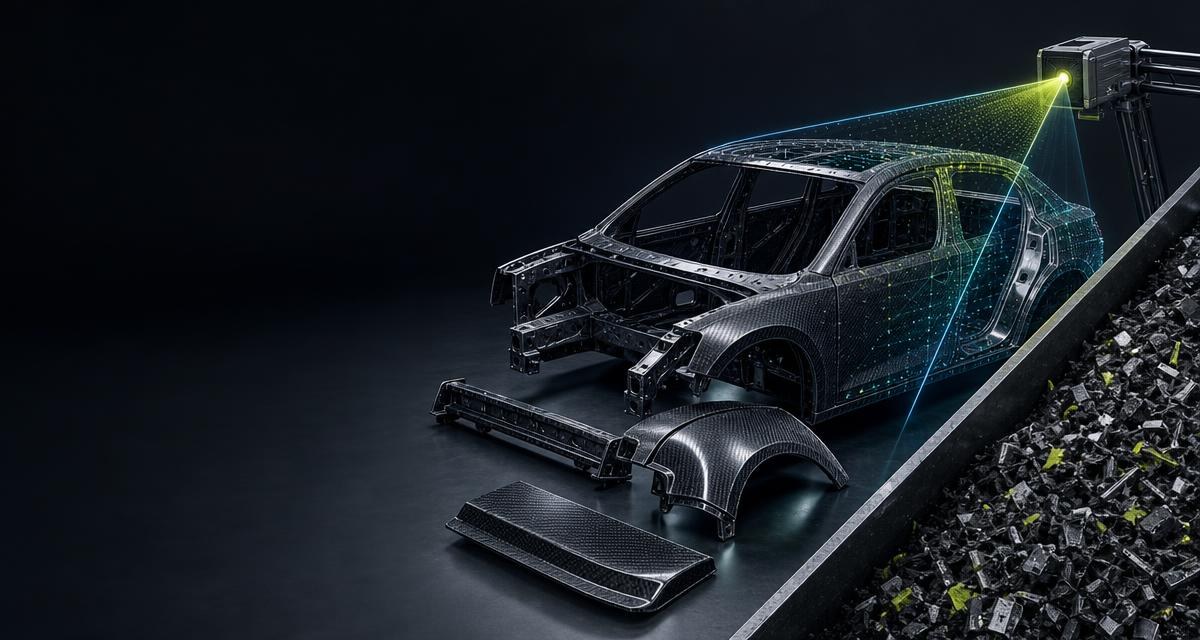
Carbon-fibre reinforced polymer combines fibres and resin into a composite that cannot be separated like steel or aluminium. Germany's Environment Agency notes that sufficient vehicle CFRP recycling is not yet established. The main opportunity is therefore before shredding: identify the part, assess undamaged reuse and keep the remaining material in a separate route.
Why the standard route fails
- CFRP is neither magnetically separated nor recovered like aluminium by eddy current.
- Cutting may release fine fibres and electrically conductive dust, requiring risk assessment and technical controls.
- Paint, adhesive, inserts and mixed composites impede clean processing.
- Thermal or chemical processes recover fibres with differing quality and economics.
- Unknown material records cause contamination and may affect downstream equipment.
Dismantling and data workflow
- Identify vehicle variant and component from manufacturer data, labels and OE number.
- Assess damage, repairs, drilling, delamination and mounting points with suitable non-destructive methods.
- Release reuse only for the specific purpose after appropriate quality assessment.
- Mark and store rejected parts separately as CFRP or mixed composite.
- Agree recipient, acceptance criteria, packaging and recovery before removal.
- Record mass, condition, decision and handover for recovery evidence.
Fields for new and used CFRP parts
- OE/IAM number, maker, vehicle and installation variant
- Material, matrix, reinforcement and known inserts
- Structural or trim role and safety relevance
- New, used, repaired, damaged or waste status
- Method, images, repair limits and release state
- Mass, location, recipient and intended recovery route
Sources and legal references
Frequently asked
Can every carbon part that looks intact be reused?
No. Hidden delamination, prior damage and structural purpose require a component- and use-specific assessment.
Is CFRP ordinary plastic waste?
A blanket classification is unsuitable. Composite design, hazards, worker protection and recipient criteria must be established.
Does tapinomahub identify CFRP automatically?
The public API provides no binding material proof. It can support label and OE identity; material release needs reliable product data.
This article is general professional guidance and does not replace legal advice. The applicable statute and the conditions imposed by your competent authority prevail.