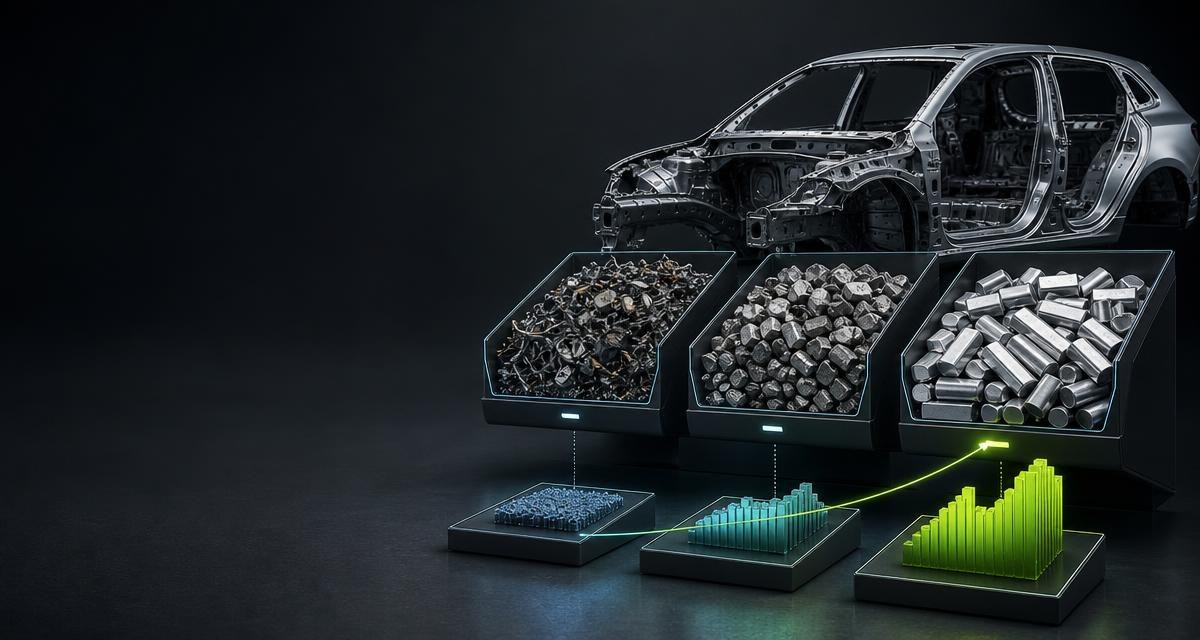
Roughly three quarters of a vehicle's mass is metal. That share is the only part of the vehicle's value that can be weighed — and the only one where care in separation converts directly into money. The rest of the value sits in the parts, see Depth of dismantling: which parts are worth removing.
The fractions and where they sit
| Fraction | Typical origin | Note |
|---|---|---|
| Steel and iron | Body, chassis, powertrain | Largest mass, lowest price per kilogram |
| Aluminium | Engine blocks, gearbox casings, wheels, body parts | Considerably higher price, clean-sorted much higher |
| Copper | Wiring harness, electric motors, starters, alternators | High price, but almost always installed and insulated |
| Lead | Starter battery, balancing weights | Its own disposal route, to be captured separately |
| Magnesium | Individual casings and carriers | To be kept separate, its own fire behaviour |
| Precious metals | Catalytic converter and exhaust components | Highest value density, see Catalytic converters: why they belong in the record individually |
Why purity makes the price
A buyer pays for material they can process without rework. Every contamination — a plastic part in aluminium scrap, a steel bolt in copper, a residue of oil in an engine block — means effort for them, and that effort is deducted from the price. Conversely: separating cleanly does not sell the same goods more cheaply, it sells different goods more dearly.
What is worth separating before the shredder
- Everything that has to come out anyway. Catalytic converter, battery, wheels and the components from depollution — mandatory and at the same time the most value-dense part.
- Aluminium in larger pieces. Engine blocks, gearbox casings and wheels are quick to identify and easy to keep separate.
- Electric motors and starters. Compact copper sources with low removal effort.
- Non-ferrous metal from radiators. Depending on construction and vehicle age, a fraction of its own.
- Everything the buyer explicitly wants separated. Fraction boundaries differ between buyers — the list comes from the conversation, not from a textbook.
The connection to the quota
Metals are largely recovered through the shredder and sorting chain anyway and therefore carry a large part of the recovery quota. What decides the quota is the remaining quarter — plastics, glass, textiles — which is hard to separate after shredding. Every component removed cleanly beforehand improves the balance twice: as avoided light fraction and as a better-paid material stream. See Recovery quotas: understanding the 95 and 85 per cent targets.
What to document
- Quantity per fraction and transfer, from the acceptance documents and not from memory.
- Recipient and date, for every stream.
- Assignment to the vehicle where possible — the basis of any analysis of what a vehicle actually returns, see Vehicle purchasing: what an end-of-life vehicle is really worth.
- Settlement basis, so that prices can be compared over time.
Planning joins vehicle context with measured operations
Vehicle data can narrow design and assemblies but not return exact kilograms of copper, aluminium or magnesium in the physical vehicle. Manufacturer information, inspection, measured time and weight, and the buyer's net offer are also required.
Operating case: does this model's wiring harness pay?
The business samples five comparable vehicles. VIN and record identify the model; the operator captures removal time, usable weight, contamination and final settlement. Only then is an ERP rule released.
| Input | Example | Role |
|---|---|---|
| Vehicle context | GET /vin/{vin}/vehicle and available assignments | Group comparable vehicles |
| Own measurement | Minutes, net weight, purity and tools | Represent real effort |
| Buyer data | Fraction price, deductions, minimum lot, transport | Calculate achievable net proceeds |
| ERP rule | Remove, remove with spare capacity, or shredder route | Give a clear instruction |
The German Environment Agency reports that metal fractions contributed 74.2 percentage points to German ELV recycling and recovery rates in 2023. This shows importance, not model profitability.
KPIs: net proceeds per fraction, contribution per work minute, kilograms per model, contamination deductions, forecast-to-scale variance and rules backed by sufficient samples.
Sources and legal references
Frequently asked
Which metal fraction earns most?
Per kilogram the precious metals in the converter, in mass the steel share. The biggest lever, however, is purity: cleanly separated aluminium achieves a multiple of mixed scrap.
Is removing the wiring harness worth it?
It depends on the time required and the copper price. The answer should be measured once across several vehicles rather than estimated.
Which fractions must I keep separate?
Those the buyer requires and those with their own disposal routes — lead from batteries, for instance. The specific boundaries differ by buyer.
Do metals count towards the recovery quota?
Yes, and they carry the largest part of it. What decides whether the targets are met is nonetheless the non-metallic remainder.