- Euro emission standard
- The Euro standards are European limit values for pollutants in vehicle exhaust. They apply to the type approval of new vehicles and are tightened in stages. In the vehicle papers the classification appears as an emission key number.
The stages at a glance
| Stage | From | Defining technology |
|---|---|---|
| Euro 1 | 1992 | The regulated catalytic converter becomes standard on petrol engines |
| Euro 2 | 1996 | Tightened limits, separated for petrol and diesel |
| Euro 3 | 2000 | On-board diagnostics, considerably stricter limits |
| Euro 4 | 2005 | Further reduced limits |
| Euro 5 | 2009 | Diesel particulate filters become effectively necessary |
| Euro 6 | 2014 | Nitrogen oxide reduction on diesels, later real-driving emissions testing |
| Euro 7 | adopted | Further development of the limits; check application dates per vehicle category |
The years refer to new type approvals. First registrations of an already approved model line can happen later — a vehicle from 2010 is therefore not necessarily Euro 5.
Where the emission class appears
The German registration certificate part I carries the emission key number from which the class follows; fuel type and emission values sit alongside. Where exactly is shown in the field overview in The registration certificate: the fields that matter in the yard. A vehicle identification can additionally look the entry up where the data source holds it.
Why it matters in a dismantling yard
- Vehicle value. The emission class helps decide whether a vehicle is still wanted as a used car or goes to treatment — and therefore the purchase price, see Vehicle purchasing: what an end-of-life vehicle is really worth.
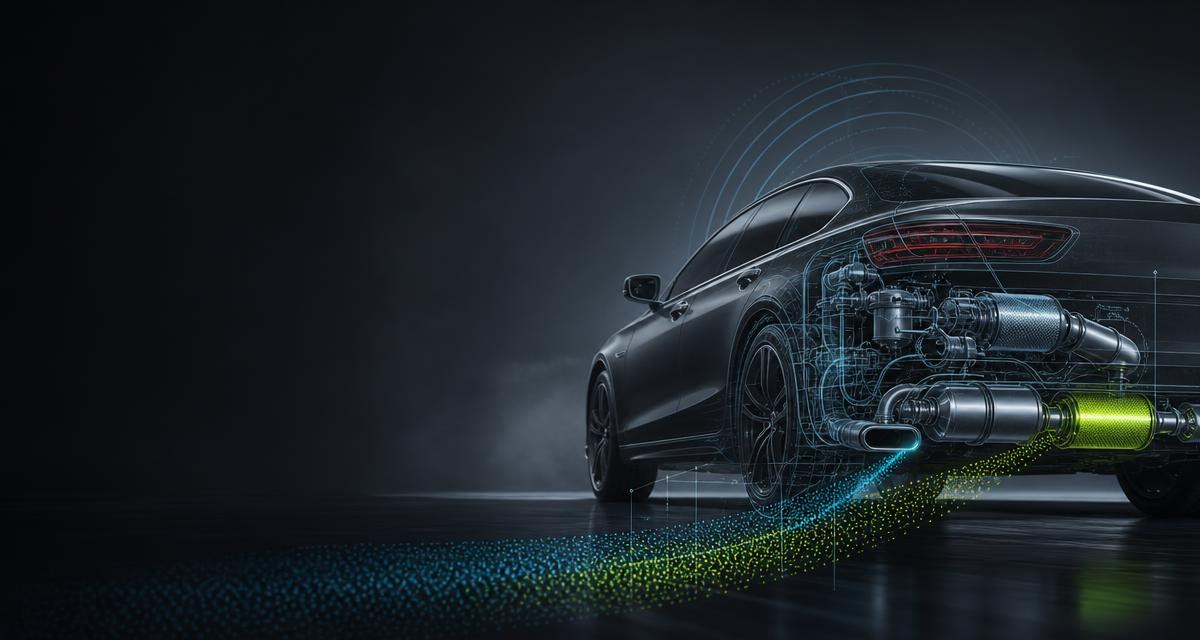
- Components in the exhaust line. The higher the stage, the more after-treatment: catalytic converter, particulate filter, sensors and, on newer diesels, the nitrogen oxide reduction system with tank and dosing unit.
- Parts demand. Exactly these components are expensive new and therefore sought after in the used market — the catalytic converter is only the best known.
- Export questions. The emission class influences whether a vehicle can be registered abroad — and therefore the line between used car and end-of-life vehicle, see Used vehicle or end-of-life vehicle? The line that decides export.
What belongs in the listing
For exhaust after-treatment components the donor vehicle's emission class is a useful additional entry — not as a substitute for the OE number but alongside it. On these components buyers often search via vehicle data, because the part number on a sooted housing is hard to find.
The usual rule applies in reverse: what is not evidenced is not asserted. An emission class inferred from the build year is a guess. If it is not in the papers and the lookup does not return it, the field stays empty.
Operating case: prioritise the exhaust system, value it separately
User story: As a dismantler, I want to recognise the exhaust-system context at intake so the catalyst, particulate filter, sensors and EGR components enter the right inspection and dismantling route. A parts trader uses the same context to make new and used stock searchable by vehicle and emission class without inventing a material value.
| Step | What comes back | Decision |
|---|---|---|
| Read the document | POST /scanner/document/registration returns data including fuel, emission class, CO₂ value and vehicle details where legible | Prefill the vehicle record and routing |
| Verify the field | V.9, 14 and 14.1 are checked against document and vehicle | Do not accept OCR errors or blanks unchecked |
| Identify the component | The OE number and GET /parts/oe/{oeNumber} provide part name, maker, available fitments and references | Value the concrete component, not merely the vehicle class |
| Set the value | Condition, exact reference, buyer quotation and, where needed, material analysis | Choose sale, remanufacturing or material recovery |
Measure it: Track fully classified exhaust systems, manual corrections after document extraction, parts without an OE reference and variance between initial estimate and realised proceeds. This rewards sound identification without false precision.
Sources and legal references
Frequently asked
How do I know a vehicle's emission standard?
From the emission key number in the German registration certificate part I. A vehicle identification can additionally look it up where the source holds it.
Does the build year say anything about the standard?
Only roughly. The years of the Euro stages refer to new type approvals; first registrations of already approved model lines can come later.
Is the environmental sticker the same as the standard?
No. The sticker assigns vehicles to pollutant groups and, on diesels, also depends on the particulate filter. Driving bans in individual cities follow their own rules.
Why are exhaust components in demand on the used market?
Because they are expensive new. Converters, particulate filters and nitrogen oxide reduction components are among the positions where the price gap to a new part is largest.