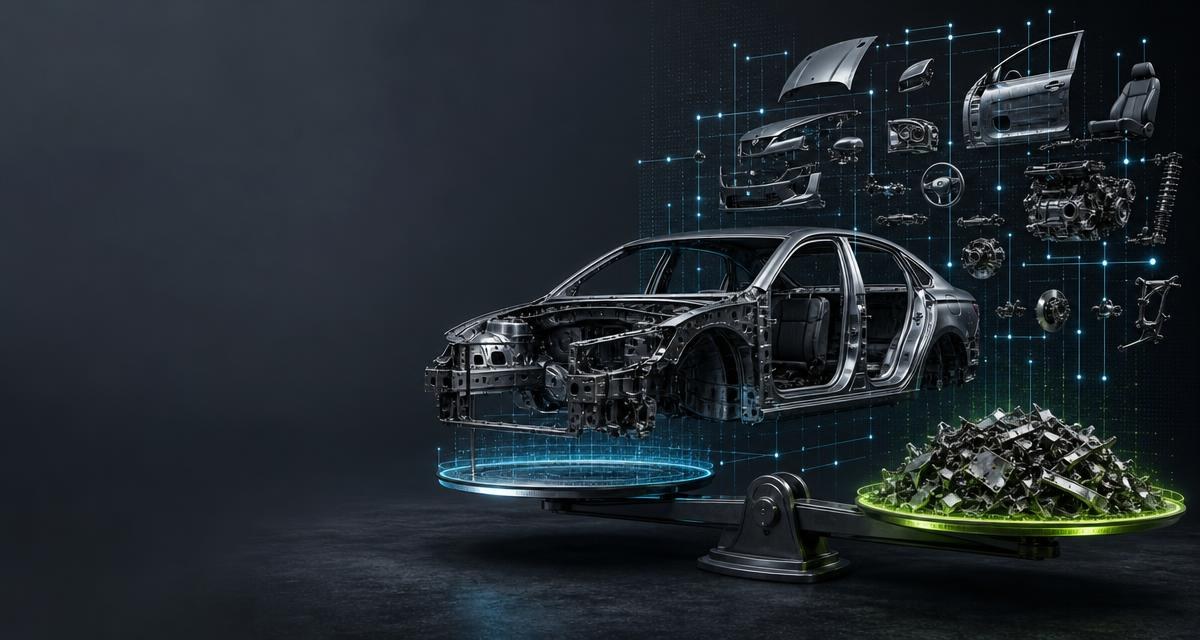
A vehicle's return is decided at purchase, not at sale. Buy too dear and you work the margin away however well dismantling runs. Buy too cautiously and you never get the interesting vehicles. Between the two lies a calculation with four components.
The four components of value
| Component | How it arises | How certain it is |
|---|---|---|
| Parts revenue | Sum of sellable components over the holding period | The largest and the least certain item |
| Metal value | Hulk and metal fractions by weight | Well calculable, but price dependent |
| Precious metals | Catalytic converter and further exhaust components | Considerable, see Catalytic converters: why they belong in the record individually |
| Costs | Transport, depollution, dismantling time, storage, disposal | The item most often set too low |
Parts revenue decides success and is the only component that cannot be weighed. It depends on model line, equipment, condition and market — and on how deeply the business dismantles, see Depth of dismantling: which parts are worth removing.
What should be known before quoting
- Vehicle identity. VIN, model line, year, engine, gearbox. These come from a lookup, not from looking at it — see VIN lookup in practice: process, result, billing.
- Equipment. It decides which parts are interesting. A vehicle with high-grade equipment is worth considerably more at identical sheet metal.
- Condition and completeness. Missing components reduce value immediately; an already-removed catalytic converter is the classic case.
- Legal classification. Goods or waste — that decides the onward route and the costs, see Used vehicle or end-of-life vehicle? The line that decides export.
- Your own history. What have comparable vehicles actually returned in this business?
The typical miscalculations
- Forgetting the holding period. A part sitting on a shelf for eighteen months has incurred storage cost and tied up capital.
- Calculating from the best price. The highest price once achieved for a control unit is not an expected value.
- Underestimating dismantling time. Removal, cleaning, capture and storage are labour, even when they never appear as an invoice.
- Overlooking disposal costs. What is not sold has to go, and that costs differently per fraction.
- Treating metal value as a floor. It is a floor for the hulk, not for the vehicle including all costs.
Which vehicles pay
There is no universal answer — it depends on your sales channel, your storage and your customer base. But recurring patterns exist:
- Common model lines deliver many parts with many buyers, but also many competitors and low prices.
- Discontinued model lines deliver less demand per part but often without a competing offer — and therefore better prices.
- Young accident vehicles deliver high-grade, sought-after parts but cost accordingly to buy.
- Vehicles with expensive equipment deliver components whose new price makes the used market attractive.
Which pattern applies to your business is in your own numbers, and nowhere else. A market valuation delivers the revenue potential of the parts; which model lines actually pay in your business only shows once it is reconciled with your own sales.
Parts potential is not the maximum purchase price
GET /vin/{vin}/economic-evaluation returns evaluated-parts potential as min, average and max, a ranking and a recommendation based on documented assumptions. Material, transport, fees, labour, testing, storage, platform costs, risk and actual condition are not automatically covered in full.
Operating case: 20 minutes before auction close
The buyer enters VIN, condition and cost assumptions. The analysis values a limited number of relevant parts and may first return a job. The system then presents three scenarios rather than one supposedly certain price.
| Scenario | Use | Release rule |
|---|---|---|
| min | Stress case for slow sales or weaker prices | Bid remains viable after safety margin |
| average | Internal working value | Only with condition, own costs and history |
| max | Opportunity case, not automatic proceeds | No bid basis without documented reason |
- Check top parts: damage, completeness and saleability.
- Add material: combine own weight or yield with the current net offer.
- Deduct costs: collection, fee, treatment, work, storage and selling.
- Limit risk: missing keys, high-voltage, fire, flood and structural damage.
- Learn: attach forecast, approval and actual return to one vehicle record.
KPIs: forecast variance, contribution per vehicle, loss rate, sell-through of top parts, days to break-even and reasons for variance.
Sources and legal references
Frequently asked
Can the value of an end-of-life vehicle be calculated flatly?
Only the metal share. For parts revenue a market valuation delivers the revenue potential from offers; whether it materialises in your own business depends on model line, equipment, depth of dismantling and your own sales, and only your own history shows that.
Which datum matters most at purchase?
The VIN. It leads to model line, engine and equipment — and therefore to everything that determines parts revenue.
How do I account for missing components?
As an immediate deduction. A missing converter or a removed control unit takes out exactly the item that would have carried the purchase.
When does an own analysis start to pay?
As soon as part sales hang off vehicles. After a few months it becomes visible which model lines actually carry the business — and that is a different list from what most expect.