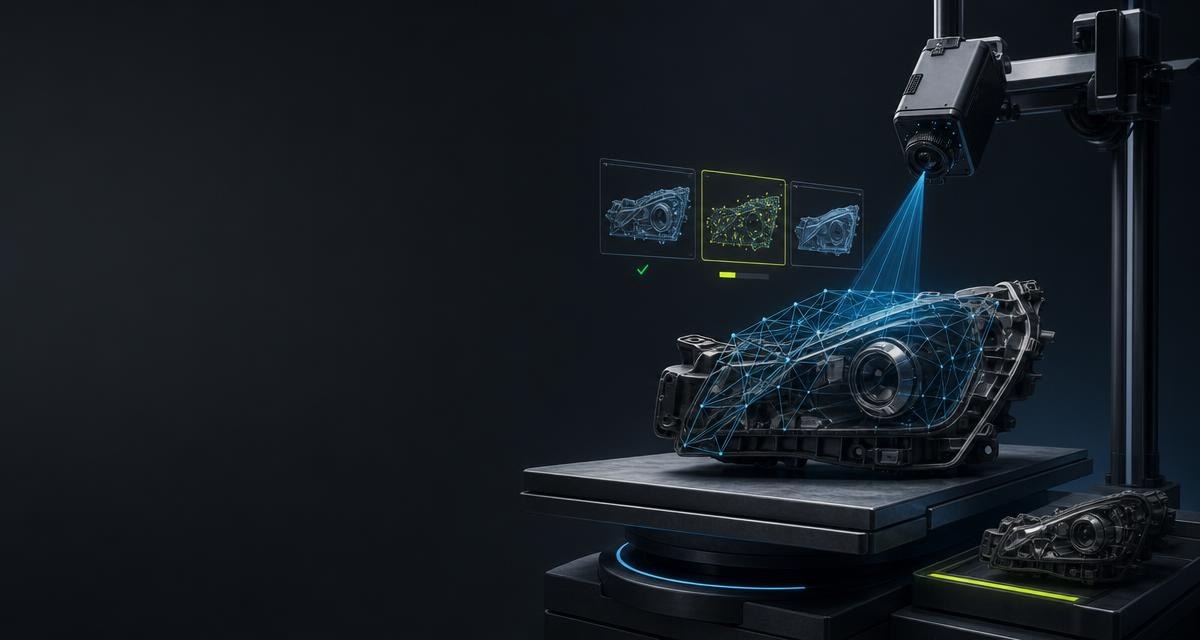
Image recognition in the parts store is no longer an experiment: a photo of a type plate returns part numbers, manufacturer and version levels in seconds. But the benefit does not arise where the model is right — it arises where the business notices that it is wrong. This text describes the line between the two and what it means for process, law and liability.
What works reliably today
- Reading characters. Printed numbers, manufacturer, hardware and software levels from a sharp label photo — text recognition with context, and the strongest discipline.
- Determining the part type. A headlight is recognisable as a headlight; assignment to a part family works even on mediocre photos.
- Grading visible condition. Scratches, corrosion, deformation and completeness can be assessed against fixed criteria when the photo shows the component.
- Cutting out the object. Determining an outline and removing the background is routine today — as long as the object lies fully inside the frame.
Where it fails systematically
| Error type | How to spot it | Countermeasure |
|---|---|---|
| Invented number | A plausible string in the manufacturer's format that does not exist | Check every number against reference data, never adopt unchecked |
| Confused variant | Part type right, version wrong (left/right, LED/halogen) | Capture variant attributes separately and check against the vehicle |
| Invisible damage | Component looks flawless and is defective inside | Mark visual inspection as such, require a functional test |
| Poor source image | Thumbnail, reflection, shadow, cropped part | Retake the photo instead of interpreting the result |
The approval threshold — the actual process
- Adopt automatically only when the number is confirmed against reference data and the photo passes the quality check.
- Send to the review queue when several candidates exist, confidence is low, or image and vehicle context contradict each other.
- Stop for safety-relevant parts: airbag, belt tensioner, brakes, steering, driver assistance sensors. There a human decides, whatever the confidence.
- Always log which field came from which source — model, reference match or human. Without that column you cannot later explain how a value came about.
What the AI Act says about it
Regulation (EU) 2024/1689 entered into force on 1 August 2024 and has applied since 2 August 2026, with staged exceptions. Three points are practically relevant for parts recognition in a store: classification as high-risk follows the rules in Article 6 and does not normally catch plain stock capture; whoever operates a system still carries obligations from their role as a deployer; and where content is generated rather than measured, it belongs marked as such. None of this is a reason to avoid image recognition — but it is a reason to settle your own role and the labelling of generated content once, properly.
The services that do this in practice
POST /scanner/label/extract-all reads every recognisable entry on a label, GET /parts/oe/normalize and POST /parts/identify turn that into a confirmed number with status and reasons, POST /vision/part/quality returns a condition grade with individual criteria and gradable: false when the image is unsuitable, and POST /vision/part/remove/bg cuts out without redrawing the object. The full route from photo to listing is in From part photo to listing: the image route through the tapinomahub API.
Limits
- Input quality is part of the result. A 200-pixel thumbnail contains no readable type plate; submitting it anyway invites the guess.
- No image evidences fitment. The assignment comes from the confirmed number and the reference data.
- Mind personal data. Number plates, faces and workshop surroundings in photos are personal data; processing them needs a legal basis.
- Instance identifiers do not belong online. Make serial numbers and device identifiers unreadable before publication — Anonymising identifiers on part images without losing the OE number.
The measure of a good rollout is therefore not the recognition rate but the correction rate after publication: how often did someone have to intervene afterwards, and how often did a customer find the error instead of your own review step?
Sources and legal references
Frequently asked
Is parts recognition a high-risk AI system?
Classification follows Article 6 of the AI Act and the specific purpose. Plain stock capture does not normally fall under it; your own role as a deployer should still be settled.
What happens when the model recognises nothing?
The field is absent from the response. No likely number is added; the record gets a task and the part is stored without a number.
How high should the approval threshold be?
It is measured, not guessed: take a sample from your own stock and find the confidence level at which the correction rate falls below your target.
May I use generated product images?
Yes, if they are marked as generated and not passed off as a photo of the item sold. For a specific used part your own photo remains decisive.