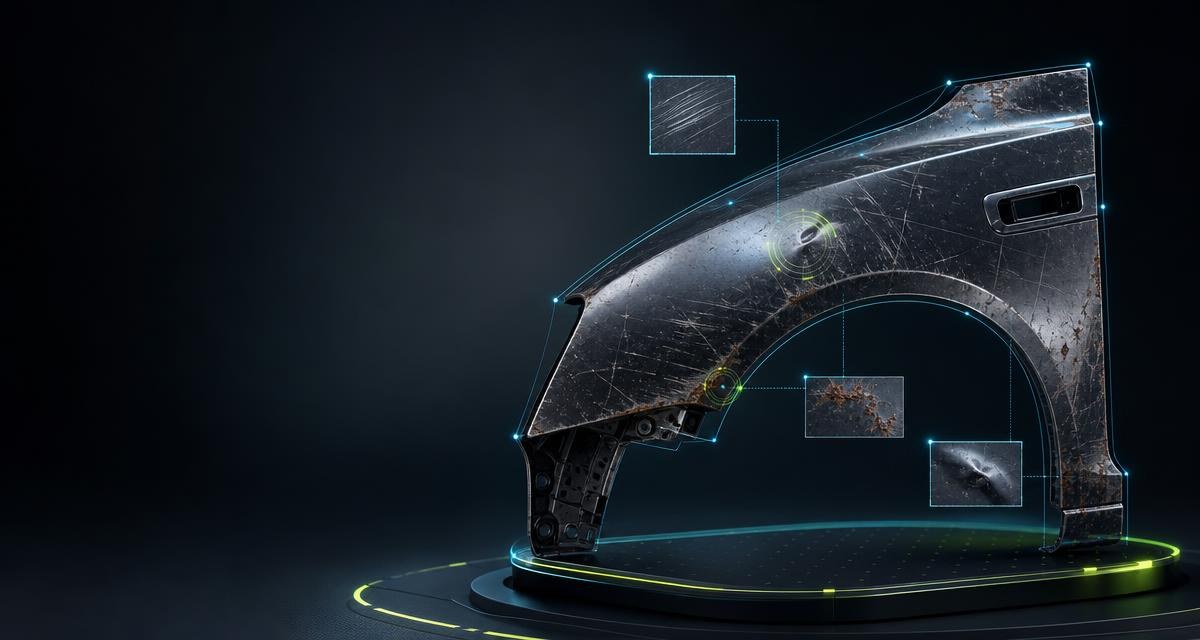
“Used, good condition” says almost nothing. The seller may mean a small scuff; the buyer expects a part ready to fit. A consistent image assessment separates observation from expectation: it names visible findings, classifies the rework required and records what the images do not show.
Condition grade and damage description are two results
| Evaluation | Question | Result |
|---|---|---|
| Quality grade | How much visible rework is required? | Grade A, B or C, seven criteria, rework and refinishing effort |
| Damage description | Which visible findings are located where? | Report with fixed sections for deformation, scratches, paint, corrosion and attachments |
At tapinomahub, POST /vision/part/quality returns the grade and POST /vision/damage/describe the structured text. Both can originate from the same images but must not be conflated: a grade helps sorting and pricing; a description explains the actual finding to the buyer.
Seven criteria instead of a gut feeling
- Signs of use: visible wear without a premature claim about its cause.
- Corrosion: visible rust or a surface the images do not allow to be assessed.
- Deformation: deviations in edges and surfaces as far as perspective and framing reveal them.
- Scratches: visible marks with their position on the part.
- Paint condition: for example abrasion or a visible need for surface repair.
- Completeness: visible attachments, brackets and mounting points.
- Contamination: because dirt can be both a finding and something that hides other findings.
Each criterion receives a rating ranging from no visible finding to severe, or is marked not assessable, plus a short observation. The grade follows the worst assessed criterion. Seven observations therefore do not become an average that hides one material defect among six good points.
What A, B and C actually mean
| Grade | Meaning | What it does not mean |
|---|---|---|
| A | Reusable without rework as shown in the images | No functional or dimensional test |
| B | Minor visible rework required | No promise of a particular selling price |
| C | Noticeable visible rework required | No judgement that the part is technically unusable |
The images decide the scope of the statement
- Take an overall view. The complete part and its orientation must be recognisable.
- Add a second and third perspective. The quality grade accepts up to three images of the same part; the damage description up to five.
- Show findings deliberately. Scratches, edges, brackets and connectors need a sharp detail image.
- Check light and cleanliness. Reflections, shadows and dirt otherwise become limitations in the result.
- Do not mix objects. Every image in one call must show the same item.
More images do not automatically produce a better grade. They reduce the blind area. If the rear is absent, the result must remain open there; a plausible addition would not be an observation. Part photography: how images sell used parts explains how to build a listing-ready image sequence.
From result to listing
- Store the grade as a filter and sorting attribute on the part record.
- Show the decisive observations in plain language in the listing.
- Publish the original images with the finding instead of using text as the only evidence.
- Do not hide limitations such as a missing angle or contamination.
- Record functional and dimensional checks separately and never derive them from the image grade.
Frequently asked
Is grade A a functional guarantee?
No. A only means that the part appears reusable without rework in the submitted images. Function, noise, play and dimensions are not tested.
How many images should I submit?
The quality grade accepts up to three and the damage description up to five images of the same part. An overall view, the rear and one relevant detail are a useful starting point.
What happens with poor images?
Criteria that cannot be assessed and other limitations are reported. If the material is insufficient overall, the grade remains empty instead of being guessed.
Does the damage description replace the condition grade?
No. The grade classifies rework; the description names visible findings. A process may need one or both.