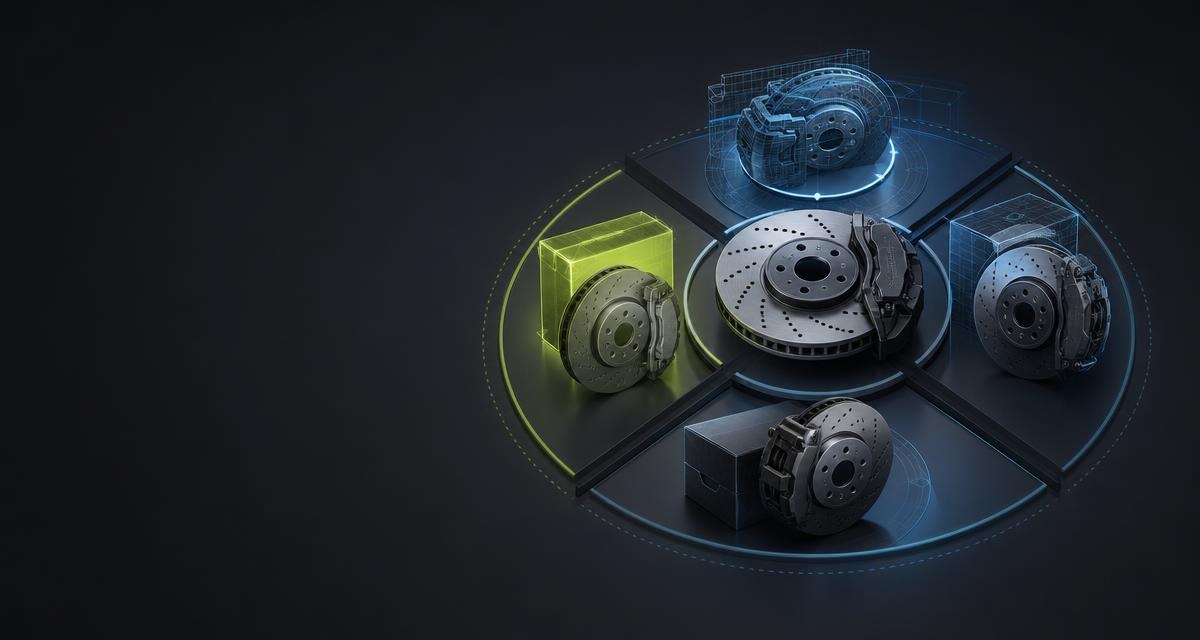
Few sets of terms are confused as often in the parts market as these four. The reason is that they do not answer the same question: two name roles, one a quality and one a market. Sort them that way and it becomes simple.
| Abbreviation | Kind of term | Meaning |
|---|---|---|
| OEM | Role | The vehicle manufacturer — see OEM: vehicle makers, suppliers and original-equipment quality |
| OES | Role | The supplier producing for the vehicle manufacturer |
| OE | Quality | Original-equipment quality, the factory specification |
| IAM | Market | The free spare-parts market beside the franchised network — see IAM: the independent aftermarket and where dismantlers sit in it |
How they relate
The OEM defines how a part must look and perform and issues an OE number for it. The OES develops and builds it. The result has OE quality, because it matches the specification. And the same OES may additionally sell that part in the IAM under its own brand.
That produces exactly the situation that confuses customers: the same component sits at the franchised dealer in a box with the vehicle maker's logo and in the free trade in a box with the supplier's logo — technically identical, often far apart in price.
And where does the used part sit?
An original part removed from a vehicle takes its own position in this order — a strong one: it was the original equipment. It does not merely match the specification, it is it. It is sold in the IAM, that is outside the franchised network.
| Route | Origin | Typical price level |
|---|---|---|
| Original part at the franchised dealer | OEM packaging, built by the OES | Highest |
| Original-equipment part in free trade | OES packaging, the same production | Below that |
| Replica | Third party without original-equipment reference | Lower, quality variable |
| Used part from an end-of-life vehicle | The original part itself | Considerably lower, original fitment |
Selling used parts therefore does not mean competing with the dealer's new part but with the replica — and winning there with an argument the replica does not have. On the product groups see New, used, remanufactured, replica: four terms, two dimensions.
What that means in a listing
- Write „original part“ rather than „OEM part“. It is more accurate and buyers search for it just as much.
- Give both numbers — the vehicle maker's and the supplier's, where they are on the part. Buyers search with both.
- State the originality explicitly. It is the core of the offer and appears surprisingly rarely.
- Do not advertise OE quality where original part is true. One is a specification statement, the other a fact — and the fact is stronger.
Frequently asked
What is the difference between OE and OEM?
OEM denotes the vehicle manufacturer as a role. OE denotes a quality, namely the original-equipment specification. A part in OE quality need not carry the OEM's brand.
Is an OES part worse than an OEM part?
Often it is the same part from the same line, differently packaged. Differences arise where the supplier offers a deviating version for the free market.
Does a used part belong to the IAM?
Yes. It is traded outside the franchised network and is therefore part of the free market — while being of original origin.
How do I tell whether a part is original equipment?
By the numbers and brands on the part itself. A component from a vehicle usually carries both — the vehicle maker's and the supplier's.