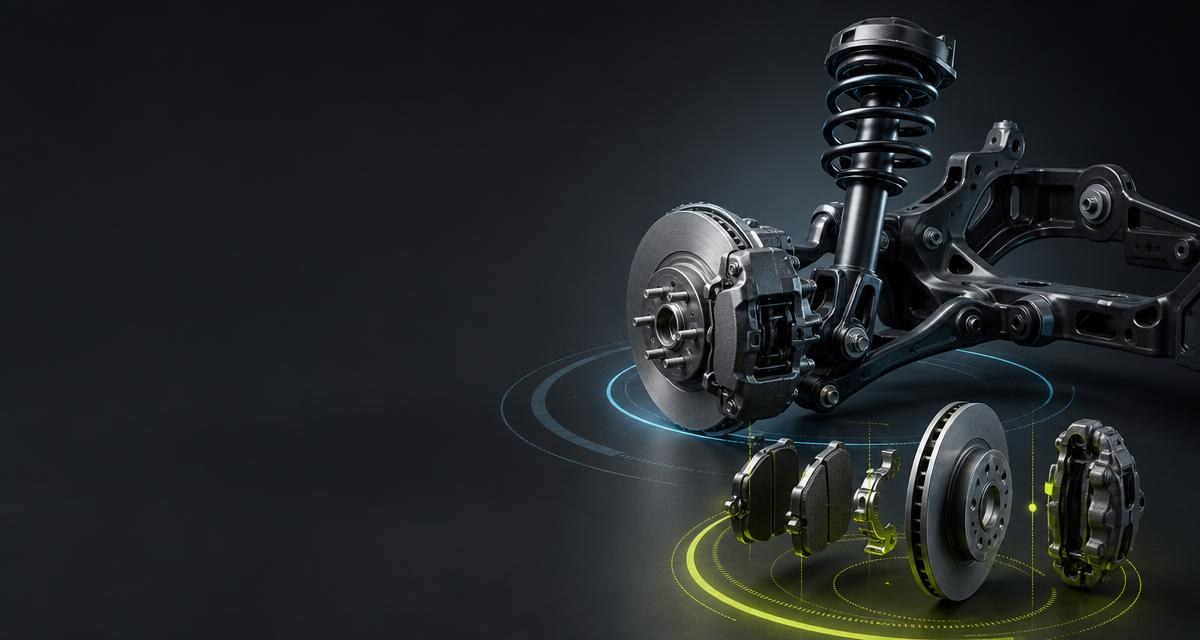
Suspension and brakes are the assemblies where a dismantler carries the most responsibility. Not because the law is especially strict here, but because a wrongly sold component is directly safety-relevant. That makes it worth having a clear house line on which parts leave the yard and which do not.
The dividing line: wear or not
| Group | Examples | As a used part |
|---|---|---|
| Outright wear parts | Brake pads, discs, dampers, rubber bushes | As a rule not sensible |
| Carriers and housings | Steering knuckles, wishbones without a wear point, caliper carriers, hub carriers | Sensible, with a clear condition statement |
| Assemblies with electronics | ABS and stability units, sensors, air suspension components | Sensible, with a note on adaptation |
| Safety-critical parts with a deformation history | Anything from the damage zone of an accident vehicle | Do not pass on |
That last row is the most important. A wishbone from the damage zone of an accident vehicle often looks undamaged and is not. If you cannot rule that out with confidence, you do not sell it — that is not a legal but an operational decision, and it should be written down in the business.
What can be checked
- Visual check for deformation. Best against the counterpart from the same axle.
- Threads and mountings. Stripped or over-torqued threads devalue the component entirely.
- Corrosion in load-bearing areas. Surface rust is something different from material loss.
- Bearing play and boots, where present.
- Donor vehicle mileage as an indicator for everything that wears.
On brake calipers add: piston movement, condition of the seals and, on electric parking brakes, the actuator motor. The latter is a component of its own with its own number — and often the very reason a caliper is being sought.
Electronics in the chassis
What used to be purely mechanical now hangs off control units: ABS and stability units, levelling, adaptive dampers, electric steering and electric parking brakes. For these the same rule applies as for any control unit — adaptation is required after fitting, and the note belongs in the listing, see Used control units: coding, immobiliser, listing.
What belongs in the listing
- [[oe-nummer|OE number]] and vehicle reference, including side and axle.
- Mileage and the result of the visual inspection, named individually.
- Origin: from which vehicle, and whether the component sat outside a damage zone.
- Approval mark where present, see Type approval, general approval and expert reports: what each paper means.
- Explicitly what was not checked. On safety-relevant components, listing the untested matters more than in any other product group.
Frequently asked
May I sell used brake parts?
Individual safety-relevant component groups carry additional requirements to be checked case by case. Independently of that, outright wear parts rarely make sense used.
What about parts from the damage zone of an accident vehicle?
They should not be passed on where deformation cannot be ruled out with confidence. For that, the vehicle file must record where the damage was.
Do ABS units need adapting?
As a rule yes. As with any control unit, the note belongs before the purchase, not after.
How do I describe the condition of an axle component?
With visual findings, the condition of threads and mountings, the degree of corrosion and the donor vehicle's mileage — and with an explicit statement of what was not checked.