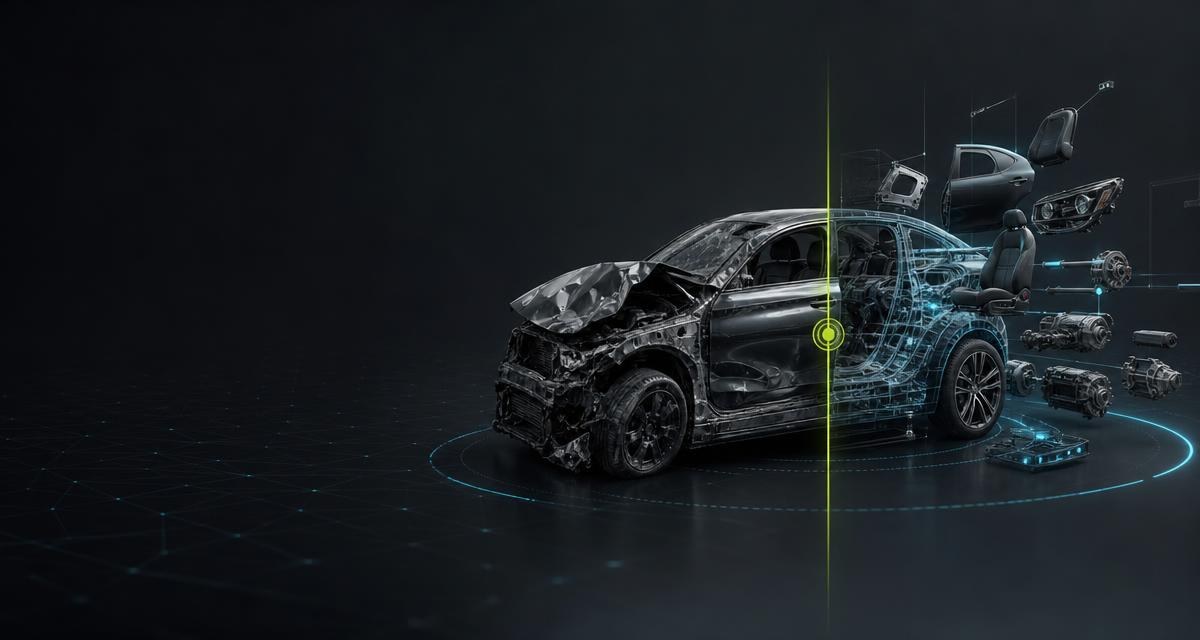
Accident vehicles are the most interesting intake source for a dismantler: the damage is localised, the rest of the vehicle is young, and the parts still in good order match current demand. Bidding here, though, means knowing the terms the other side calculates with.
The three terms everything revolves around
| Term | Meaning |
|---|---|
| Replacement value | What an equivalent vehicle would cost on the market |
| Salvage value | What the damaged vehicle still achieves in its current state |
| Repair cost | What proper repair would cost |
The relationship between the three classifies the loss. Where repair costs clearly exceed the replacement value, it is an economic write-off: repair would be possible but not worthwhile. Where proper repair is technically no longer possible, it is a technical write-off.
How salvage value arises
Salvage value is not a calculated but an achievable value: it arises from bids by interested parties, often gathered through salvage exchanges and documented in a damage report. For a dismantler that means bidding not against a formula but against other bidders — and that your own calculation decides whether a bid holds.
That calculation is the same as for any purchase: parts revenue, metal value, precious metals, costs — with the difference that part of the body is written off while the rest is younger. The method is in Vehicle purchasing: what an end-of-life vehicle is really worth.
What makes an accident vehicle special
- Young parts. On a three-year-old vehicle practically everything outside the damage zone is in demand and barely worn.
- Current model line. Demand for parts of current model lines is higher than for discontinued ones — and so is the new price.
- Concentrated damage. Front damage leaves powertrain, interior, rear and electronics untouched.
- High-grade equipment. Vehicles with expensive equipment appear disproportionately in this intake source.
That fourth line is underrated. Driver assistance, headlamps, control units and sensors are expensive new, and their used market absorbs accordingly — see Depth of dismantling: which parts are worth removing.
What to watch when assessing
- Delimit the damage zone. What is mechanically affected, what only cosmetically, what not at all?
- Check whether restraint systems deployed. Deployed airbags are an effort and a topic of their own, see Airbags and belt pretensioners: removal, storage, transfer.
- Assess distortion of the structure. It decides whether bolt-on parts still fit accurately.
- Establish fluid loss and fire traces. They affect far more components than the visible damage zone.
- Check completeness. Parts missing before collection are the most common reason a calculation does not work out.
After winning the bid
The same rules apply to treatment as for any other vehicle: legal classification, vehicle file, depollution, part capture. An accident vehicle brings two particularities, though — deployed or undeployed restraint systems and frequently escaped operating fluids. Both belong at the start of the process, not at the end.
Frequently asked
What is the difference between an economic and a technical write-off?
In an economic write-off repair would be possible but exceeds what is economically justifiable. In a technical write-off proper repair is no longer possible at all.
Is a write-off automatically an end-of-life vehicle?
No. Classification as goods or waste follows its own criteria and must be taken and documented before treatment.
How does salvage value arise?
From bids actually submitted, often gathered through salvage exchanges and documented in a damage report. It is an achievable, not a calculated value.
Why are accident vehicles interesting for dismantlers?
Because the damage is localised and the rest of the vehicle is young, barely worn and in demand for a current model line.