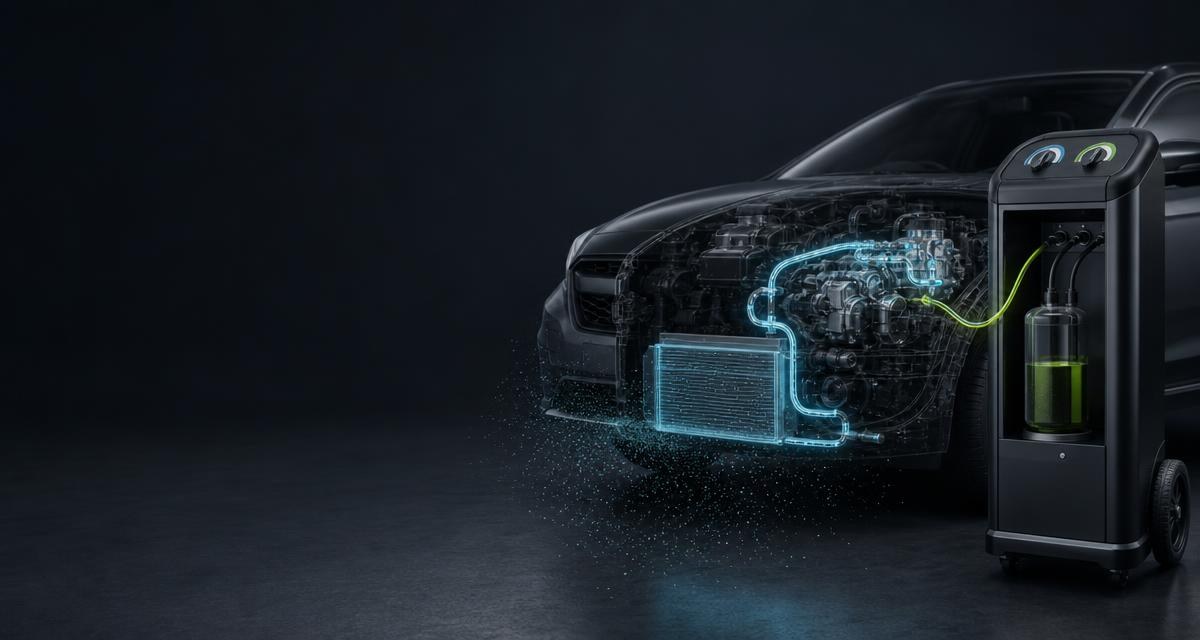
Oil drips, fuel smells, coolant stains. Refrigerant escapes as a gas, without a trace. That is precisely why it is the operating fluid where „nothing happened“ most often — and the one under the strictest rules.
Why it has to come out first
Depollution requires the air-conditioning refrigerant to be removed separately. In practice that means before any work that could damage a line. Removing the condenser without recovering first empties the system — into the atmosphere rather than into a container.
The refrigerants found in the fleet
| Refrigerant | Typical fleet | Particularity |
|---|---|---|
| R134a | Older vehicles | Fluorinated greenhouse gas with high global warming potential |
| R1234yf | Newer vehicles | Considerably lower warming potential, mildly flammable |
| R744 (CO₂) | Individual vehicles | Operates at very high system pressure |
The move away from R134a follows European rules prohibiting refrigerants with high warming potential in the air conditioning of new vehicles. For a dismantler that means both generations stand side by side in the yard, and they may neither be mixed nor treated with the same equipment without further ado.
Competence and equipment
Recovering fluorinated greenhouse gases from vehicle air conditioning carries its own requirements for the competence of the person doing the work and for the equipment used. Which evidence is required in an individual case follows from applicable law; clarify it with the competent authority.
A business without the competence and the equipment hands this step over — to a workshop or a service provider equipped for it. That is not a shortcoming but the orderly route. The handover is documented like any other disposal route.
What to document
- Per vehicle, that recovery took place, and which refrigerant the system contained.
- The quantity recovered, as far as the equipment reports it.
- Where it went: own collection vessel, handover to a third party, date and recipient.
- The competence of the person performing it, or evidence of commissioning a third party.
These entries belong in the vehicle file, not in a separate book. Refrigerant handling is regularly examined in the recurring review, and it is one of the points where gaps are noticed immediately — see Authorised treatment facility: requirements and periodic review.
And the components?
Compressor, condenser, drier and evaporator are sought-after used parts. For selling: components from a properly evacuated system are empty — a statement that belongs in the listing, because it stops the buyer expecting a charged component.
Two further notes belong with it. On an oil-filled compressor the oil level is a topic of its own, and shipping oil-bearing components carries its own requirements — see Shipping used parts: dimensions, packaging, transport damage. And as with any component: what was not tested is described as untested, not as working.
Sources and legal references
Frequently asked
May I simply vent the refrigerant?
No. It must be recovered separately. Recovering fluorinated greenhouse gases carries its own competence and equipment requirements.
How do I tell which refrigerant is fitted?
From a label in the engine bay. Looking there comes before connecting the recovery unit.
What if I do not have the equipment?
Then the step is handed to a business equipped for it and the handover is documented. That is the orderly route.
Can I sell an air-conditioning compressor as a used part?
Yes. The listing should note that the system was evacuated, state the oil situation and say honestly what was tested and what was not.
This article is general professional guidance and does not replace legal advice. The applicable statute and the conditions imposed by your competent authority prevail.