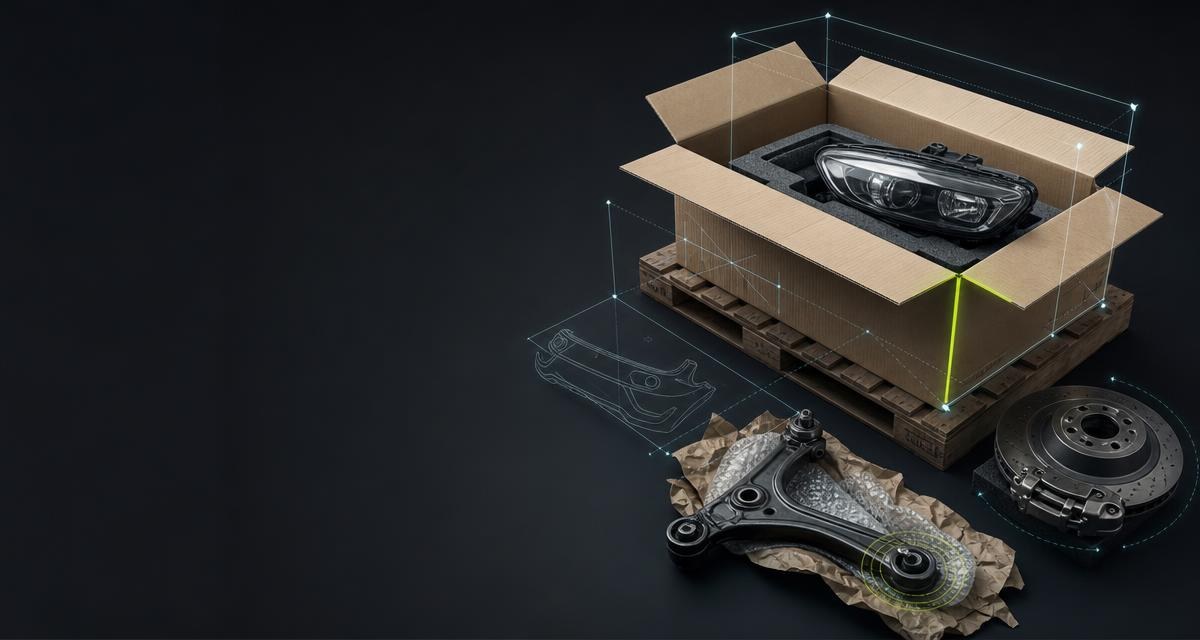
A bumper that earns 40 euros and costs 60 in freight is not a sale but a subsidy. Shipping therefore belongs not at the end of the process but in the calculation — and that needs two data points before the listing goes online: dimensions and weight.
Dimensions belong to the part number
A wing of the same OE number is always the same size and the same weight. Those data therefore belong not to the individual item but to the number. Store them once and the next part of the same kind needs no measuring — and the shipping price can be calculated at listing time.
Four size classes in dismantler shipping
| Class | Examples | What matters |
|---|---|---|
| Small and robust | Sensors, switches, small brackets | A padded envelope often suffices; do not forget the number outside |
| Compact and delicate | Control units, displays, sensors with connectors | Antistatic, firm carton, clearance all around |
| Heavy and compact | Starters, alternators, brake calipers | Double-wall carton, take weight at the base, secure oil residues |
| Bulky | Doors, lids, bumpers, glazing | Edge protection, pallet or crate, freight forwarding |
Bulky parts: the most common mistakes
- Edges unprotected. Doors and lids get damaged at the edges, not in the middle.
- Painted surfaces stacked without interlayers. Two parts against each other chafe in transit.
- Too little outer packing on glazing. Glass forgives no point loads; edge protection and a stable frame are mandatory.
- Pallet insufficiently secured. A part that wanders on the pallet arrives damaged.
- Weight declared wrongly. In freight shipping that means not only recharging but delays.
Operating fluids and dangerous goods
Components with oil, fuel or coolant residues cannot simply go into a carton. They must be packed leak-proof, and depending on the substance and quantity, dangerous-goods requirements may apply. That concerns fuel pumps, tanks, air-conditioning compressors and components holding larger quantities of oil in particular.
Separate rules apply to pyrotechnic components — see Airbags and belt pretensioners: removal, storage, transfer — and to damaged batteries, see Dismantling electric vehicles: high voltage, battery, competence. In both cases transport is to be arranged with a recipient equipped for it rather than improvised.
Transport damage: document before packing
In a dispute, transport damage is a question of evidence. Photograph the condition before packing and you can show the part left undamaged. Skip it and you argue.
- Photograph the condition before packing — the same images already in the listing, see Part photography: how images sell used parts.
- Photograph the packaging before closing it, and afterwards for bulky consignments.
- Attach the consignment number to the transaction.
- On a damage report, ask the buyer to photograph packaging and part before anything is removed.
- Know the transport insurer's deadlines; they are shorter than expected.
Frequently asked
Where do I get dimensions and weight without measuring?
They belong to the part number and can be requested as attributes for the OE number. Stored once, they hold for every unit of the same number.
How best to ship a bumper?
With edge protection and interlayers, in a stable crate or on a secured pallet, usually by freight. The freight cost belongs in the listing beforehand.
What about oil-bearing components?
Pack them leak-proof. Depending on the substance and quantity, dangerous-goods requirements may apply and should be clarified in advance.
How do I prove damage occurred in transit?
With photos of the part before packing and of the packaging before closing. Without them it is one assertion against another.