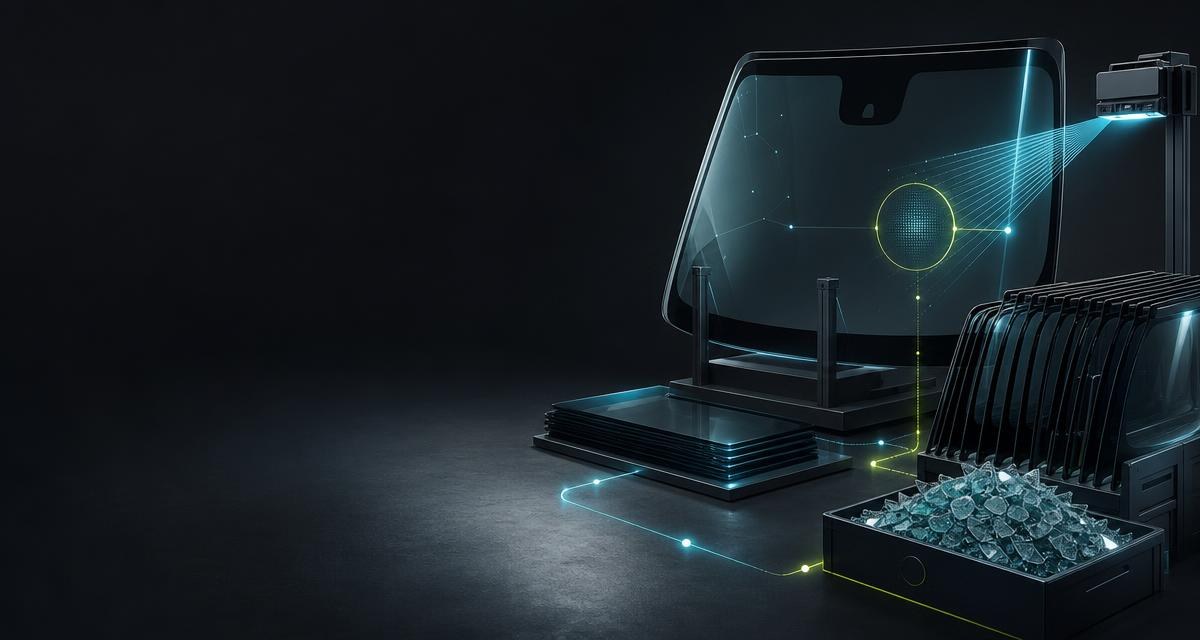
Glass is a special case in an end-of-life vehicle: heavy, bulky, fragile and low in material value — yet sometimes the only source of a spare part for older model lines. Whether a pane goes to sale or to recovery is decided at the vehicle, and the decision needs two looks: at the condition and at the marking.
Two kinds of glass, two behaviours
| Kind | Where fitted | Behaviour on breaking |
|---|---|---|
| Laminated safety glass | Windscreen, increasingly also sides and roof | Stays bonded, cracks without falling apart |
| Toughened safety glass | Conventional side and rear windows | Disintegrates entirely into small blunt granules |
The difference is felt during removal: laminated glass can be cut out whole, toughened glass is either intact or gone. It matters for recovery too, because the interlayer determines the recycling route.
The marking on the pane
Every vehicle pane carries a fired-in marking, usually in a lower corner. It regularly contains:
- The brand or mark of the glass maker.
- An approval mark with an approval number — for context see Type approval, general approval and expert reports: what each paper means.
- A statement of the glass type, for instance as a code for laminated or toughened safety glass.
- Production data in a maker-specific notation from which the production period can often be read.
- On original-equipment panes additionally the vehicle manufacturer's part number or code.
What a pane can do these days
A windscreen has long since stopped being a piece of glass. Depending on equipment it contains or carries heating fields, rain and light sensors, brackets for camera systems, acoustic interlayers, infrared reflective coatings, antenna structures and areas for head-up displays.
For the listing that means the equipment features belong in it explicitly, one by one. A pane „with sensors“ is not a statement — which sensors, in which bracket, is the statement. On vehicles with camera systems, calibration may be required after fitting; that note belongs in the listing as with any electronic component.
Removal, storage, shipping
- Photograph before removal, including the marking and the mounting position of the brackets.
- Store upright, on edge and bearing protection, never stacked flat.
- Secure against tipping. A rack is cheaper than three broken panes.
- Build a frame for shipping. Glass forgives no point loads; edge protection all around is mandatory — see Shipping used parts: dimensions, packaging, transport damage.
- Offer collection where freight exceeds the proceeds. That is more honest than a listing cancelled after purchase.
When the pane goes to recovery
Glass is among the constituents to be separated from the vehicle during depollution where it is not segregated in the shredding process. The reason is the quota: separately removed glass is a clean material stream, while in the shredder it becomes part of the hard-to-separate light fraction — see Recovery quotas: understanding the 95 and 85 per cent targets.
Laminated and toughened glass are captured separately, because the interlayer requires its own processing. Which fractions the respective buyer requires is to be agreed with them — and documented like any waste stream.
Frequently asked
How do I recognise laminated glass?
By the marking on the pane and by how it breaks: laminated glass cracks and holds together, toughened safety glass disintegrates entirely into small granules.
Where is the marking?
Usually fired into a lower corner of the pane, with the maker's mark, an approval mark and details of the glass type.
Does anything need calibrating after a pane is replaced?
On vehicles with camera systems behind the windscreen, calibration may be required. The note belongs in the listing.
Why is glass removed before shredding?
Because separately removed glass is a clean material stream. In the shredder it becomes part of the light fraction, whose separation is technically demanding.