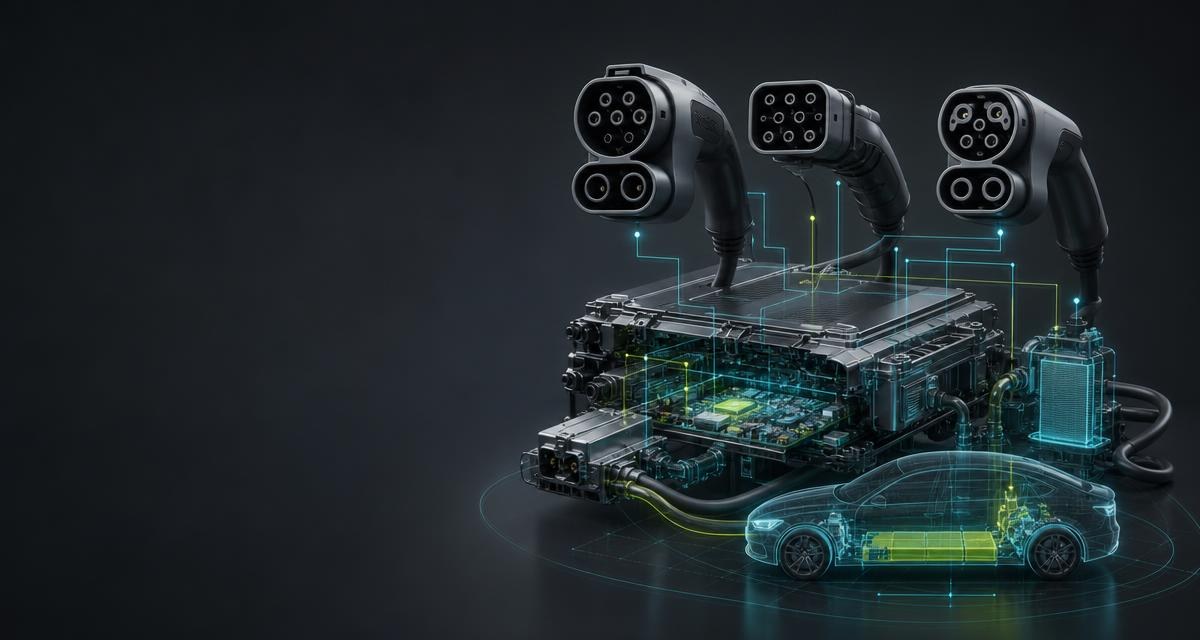
Electromobility creates a parts family spanning vehicle, energy supply and software. Charge inlets, cables, onboard chargers, DC/DC converters and controllers often look similar across models but are not automatically interchangeable. New- and used-parts catalogues therefore need more than a label such as CCS charger.
Separate components and functions
- AC inlet and Type 2 connection: carry alternating current and communicate with charging equipment.
- CCS/Combo 2: adds DC contacts; inlet, lock, wiring and sensing form a vehicle-specific system.
- Onboard charger: converts AC for the traction battery and determines supported phases and power.
- DC/DC converter: supplies the low-voltage system from the HV battery.
- EVSE/wallbox components: belong to infrastructure and follow different product and operator requirements from vehicle parts.
Verify compatibility
- Capture OE/IAM number, manufacturer, hardware and software level.
- Record AC or DC, connector, phases, rated voltage, current and power.
- Match model, battery variant, production period, market and charging options.
- Compare HV, low-voltage, communication, cooling and locking connections.
- Flag coding, parameterisation, immobiliser and commissioning requirements before sale.
- Evidence fault codes, insulation and function tests with conditions and date.
Catalogue and API fields
- Component type and installation location
- OE/IAM number, maker, generation and supersession
- AC/DC, Type 2/CCS, phases, voltage, current and power
- Connector layout, lock, cooling and communication bus
- Vehicle, battery, market and equipment allocation
- Software, coding, test and safe-shipping status
Sources and legal references
Frequently asked
Does every CCS inlet fit every European EV?
The public connector standard enables charging interoperability, but internal inlets and components vary by model, power, cooling, communication and generation.
Can a used onboard charger be installed directly?
Not generally. Part number, hardware, software, coding, HV testing, cooling and manufacturer instructions must match the target vehicle.
Why store phase count and charging power separately?
Externally similar chargers can support different AC configurations, and incorrect allocation can prevent function or commissioning.