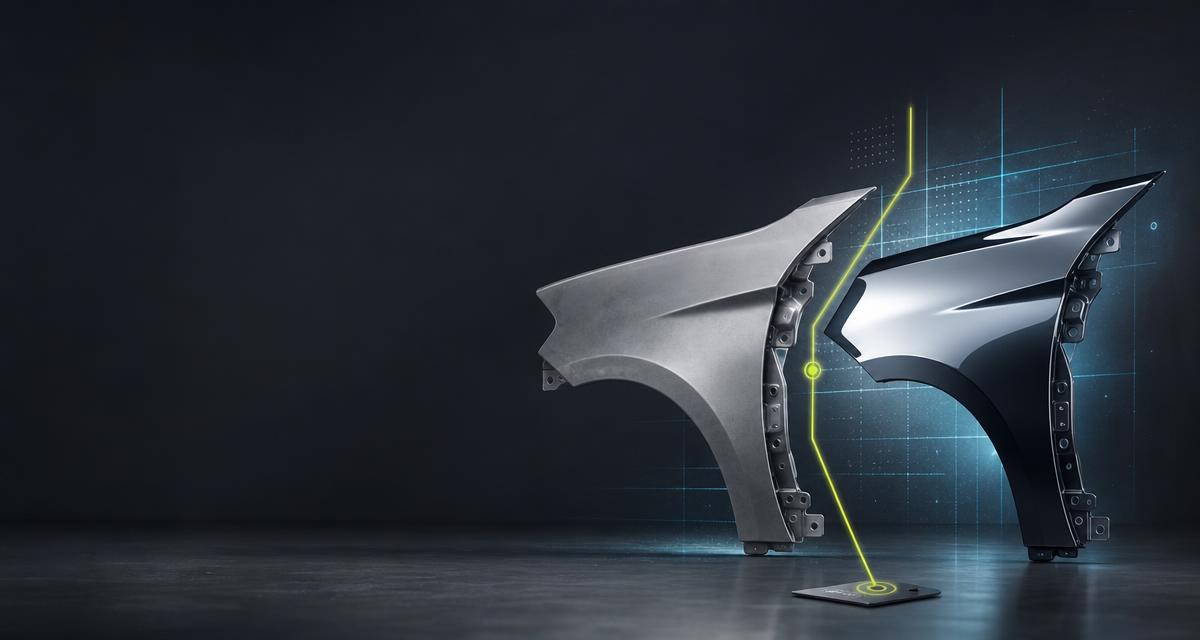
On painted body and bolt-on parts, colour is not an attribute but a component of the price. Offer a door in exactly the shade the buyer needs and you are selling a ready-to-fit part. Offer the same door without a colour statement and you are selling a part that still has to go to the paint shop — and you get paid accordingly.
Where the code sits
- On an additional plate or label, usually together with other vehicle codes. The position differs markedly by manufacturer: engine bay, spare wheel well, boot floor, B-pillar, inside of the fuel flap or service book.
- On the vehicle data sticker with the equipment codes — the paint code sits there next to the gearbox code and the engine code.
- In manufacturer data via vehicle identification, that is via the VIN.
There is no uniform format. Some manufacturers issue plain numeric codes, others letter-digit combinations, others again carry code and colour name together. The shade cannot be derived from the code itself — it is a key into the manufacturer's colour database.
Why colour must not be estimated
„Black“ is not a colour statement. Within one model line there are regularly several blacks, plus solid, metallic and pearl effect finishes. Two of them side by side on one vehicle are visible to anyone, and the buyer notices it not in a catalogue but when holding the part against the car.
If you do not have the code, write that: „Paint code could not be determined, see images for colour.“ That is an honest statement a buyer can work with. An estimated code, by contrast, is a claim that only surfaces at fitting — and then produces a return plus a paint shop invoice.
What belongs in the listing
| Entry | Why |
|---|---|
| Paint code | The only unambiguous colour statement |
| Colour name | The name buyers search with |
| Effect type | Solid, metallic or pearl — decides how repairable it is |
| Condition of the painted surface | Scratches, stone chips, respray — state them openly |
| Images in daylight | Colour cannot be judged under workshop lighting |
Images deserve particular attention here: shades shift considerably under artificial light. A shot taken outdoors under an overcast sky renders the colour far more reliably than any workshop lamp. More in Part photography: how images sell used parts.
And if the part was resprayed?
A resprayed bolt-on part does not necessarily carry the shade on the vehicle data sticker. Indicators are differences in coating thickness, overspray on edges and deviating gloss. If you suspect a respray, put that in the listing — a stated suspicion is a permissible statement, a false certainty is not.
Frequently asked
Where do I find the paint code fastest?
On the vehicle data sticker with the vehicle codes. The position differs by manufacturer — engine bay, spare wheel well, boot floor, B-pillar, fuel flap or service book.
Can I derive the colour from the VIN?
Not from the character string itself. A vehicle identification can look up the paint code where the data source holds it.
What do I write if I cannot find the code?
That it could not be determined, plus meaningful images in daylight. An estimated code is worse than none.
Is a colour statement worth it on every part?
On everything painted and externally visible — doors, lids, wings, bumpers, mirror caps. On unpainted parts it plays no role.