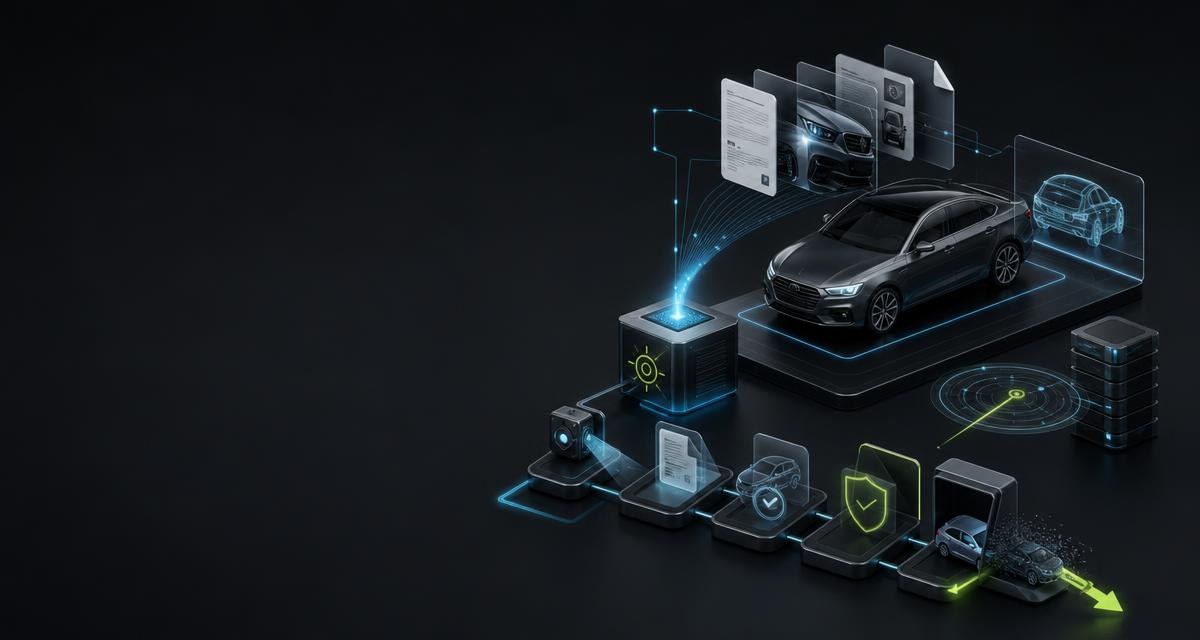
- Fleet management system
- A fleet management system manages vehicles across their whole life in a company: intake, assignment to drivers and sites, maintenance, damage, return and defleeting. It is used by leasing companies, rental firms, corporate fleets, municipalities and fleet service providers — and increasingly by dealers and dismantlers taking over fleet vehicles. This page addresses the vendors of such systems.
Where data is missing in the process
A fleet system is only as good as its master data. In practice that data is created where someone types up a document or assigns a photo by hand. Typical gaps:
- At intake. The registration certificate is typed up — for international fleets from documents laid out differently in every country. Errors in VIN, type codes or first registration travel into every later report. See The registration certificate: the fields that matter in the yard.
- In damage and driver reports. A photo arrives with a licence plate but no vehicle identifier; someone searches the plate in the stock and assigns it.
- With recalls. Manufacturer letters and register notices are checked against the stock by hand, often only once a driver asks.
- At return. Condition is ticked on a form and the photos sit unstructured next to it; in a dispute the link between finding and photo is missing.
- At defleet. Sale, export or recycling is decided without a figure basis — and without asking whether the vehicle is legally still goods. See Used vehicle or end-of-life vehicle? The line that decides export.
What the API delivers
| Process step | Call | Result |
|---|---|---|
| Intake, German registration certificate | POST /scanner/document/registration | Fields of registration certificate part I, structured |
| Intake, document from 32 countries | POST /scanner/document/registration/international | Normalised core fields plus every field read in fields with the print in sourceValue |
| Identify the vehicle | GET /vin/{vin}/vehicle | Vehicle data and a stable tapiId; provider 1 via the redirect flow |
| Assign a licence plate | POST /vision/license-plate | Characters, comparison form, country, confidence and position — no keeper lookup |
| Check recalls | GET /recalls/vehicles/{vin} | Per measure: file reference, register, defect, remedy, stop-drive flag, match confidence |
| Document the return | POST /vision/condition-report | Findings per zone in fixed order, overall grade A/B/C |
| Defleet | POST /vision/vehicle/elv-classification, GET /vin/{vin}/economic-evaluation | End-of-life classification; revenue potential min/average/max and dismantling ranking |
One process from start to finish
- Intake. The registration document goes as image or PDF via
fileUrltoPOST /scanner/document/registration/international. The normalised core fields fill the master data,sourceValuekeeps the print. Names, addresses, plates and VIN are never translated. - Identification. The recognised VIN goes to
GET /vin/{vin}/vehicle; providers 2 and 3 answer directly, provider 1 answers third-party systems withredirect_required. The backend then creates a session viaPOST /vin/redirect-sessionsfromvin,returnUrlandstateand sends the user toredirectUrl; the match runs in the tapinoma interface, the return carriesstatus=completed,tapiIdandstate— never vehicle data. The session expires after ten minutes. Structure of the number in VIN: Reading, checking and using the vehicle identification number. - Operation. A damage report arrives with a photo.
POST /vision/license-platereturns from up to 3 images the characters, a comparison form and the country as ISO 3166-1 alpha-2; the comparison form is matched against the stock. - Recalls. A nightly run calls
GET /recalls/vehicles/{vin}for the stock; the VIN is resolved only from the own, previously matched stock, with no supplier call. A measure with a stop-drive flag creates a block and a task. - Return. Up to 8 walk-around images go to
POST /vision/condition-report. The findings per zone — front, left side, right side, rear, roof, interior, engine bay, other — and the overall grade land in the return record; which image belongs to which zone is recorded by the fleet system itself, the response only carriesimageCount. - Defleet.
POST /vision/vehicle/elv-classificationclarifies from 1 to 10 images whether there is an end-of-life suspicion;gutachten_empfohlenmeans an expert report must carry the decision. For sale or recycling,GET /vin/{vin}/economic-evaluationwithprovider=1returns the parts' revenue potential asmin,averageandmax—200straight away when the parts list and valuations are already available, otherwise202with a job ID and the result viaGET /vin/economic-evaluation/jobs/{jobId}. Context in Accident vehicles: write-offs, salvage value and what matters to a dismantler and Vehicle purchasing: what an end-of-life vehicle is really worth.
curl \
  -H 'X-Api-Key: <API_KEY>' \
  -H 'Content-Type: application/json' \
  -d '{"fileUrl": "<FILE_URL>"}' \
  'https://api.tapinomahub.com/scanner/document/registration/international'
The integration
- Keep the key server-side. The
X-Api-Keylives in the backend configuration. Driver apps and browsers talk to your own server, never to the API directly. - Start with one endpoint. For a fleet system that is usually reading the registration document at intake; whoever holds a matched VIN stock starts with the recall check.
- Define the field mapping. Which document field fills which master-data field?
fieldsandsourceValueare kept, every field carries its provenance: document, match or hand. - Separate empty result from error.
404 vehicle_not_foundis a domain-level empty result, not a technical error; anullfield stays empty and raises a task. A completed image analysis is billed even without a hit. - Collect long-running calls. A
202carriesLocation,Retry-Afterand a job ID. The backend polls the job endpoint and writes the result as soon as it is there. - Roll out in stages. One tenant first, then all.
GET /client/usageshows which calls run how often;X-Tapinoma-Usage-Warningreports low credit.
What to watch out for
- Set `Idempotency-Key`. A repeated call after a dropped connection must not trigger a second analysis;
X-Tapinoma-Idempotent-Replaymarks the replay. Calls that issue a key are not replayed — after a timeout, reconcile the stock viaGET /client/users. - Leave empty fields empty. Whatever document or image do not yield comes back as
null. A plausible default is more dangerous than a visible gap. - Store the `tapiId`. It is stable, and
GET /vehicles/{tapiId}returns the technical data as part of the previously paid VIN workflow — no second match every time the file is opened. - Never put the key in the browser. Not in a driver app or a kiosk on site either.
- Rate limits per tenant. The recall run belongs in a time window, and
PUT /client/users/{clientId}/rate-limitscaps what a single user can trigger. - Check the results. Confidence on the plate, match confidence on the recall and
A/B/Con condition are statements about reliability, not decisions. What is owed is the analysis, use is the customer's — legally framed in Data in an end-of-life vehicle: what stays in the infotainment when the car goes.
What the API does not do
It does not identify a keeper: POST /vision/license-plate reads the plate from the photo without any register or keeper check. It does not replace an expert report: the condition report is a visual inspection without repair or residual-value calculation, and gutachten_empfohlen means exactly that. It guarantees no price: the economic evaluation names a revenue potential from market references, not a sale price. The recall check is a model-line-level working aid, not a vehicle-specific statement by the manufacturer. Provider 1 is reachable for third-party systems only through the redirect flow. And it sells no database: what is owed is the analysis and the output of the result. What goes into recycling can be accompanied by evidenced attributes — see CO₂ and used parts: what can honestly be said.
Frequently asked
Can the API name the keeper of a licence plate?
No. POST /vision/license-plate reads characters, comparison form and country from the photo. There is no keeper lookup and no register check; assignment happens in your own stock.
Why does provider 1 answer with redirect_required?
Because provider 1 may not be called directly by third-party systems. The backend creates a session via POST /vin/redirect-sessions, the user matches in the tapinoma interface, the return carries the tapiId. Providers 2 and 3 can be queried directly.
Is an image analysis billed when nothing is recognised?
Yes. What is billed is the analysis performed, not the hit. An empty result is not an error; a refund happens only where the analysis could not be delivered.
How do we connect many fleet customers with separate billing?
Via POST /client/partner-workspaces: one call per end customer with externalReference, its own key and activation via endpointKeys. One contract, many separately billable workspaces.