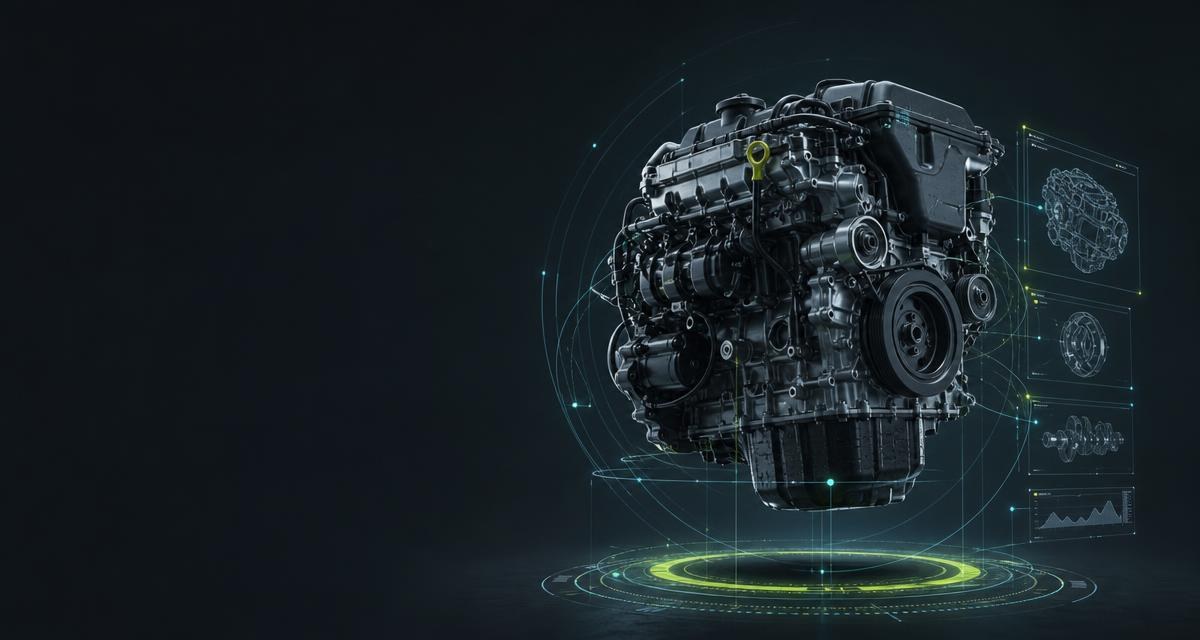
No other component combines so much value with so little testability. A removed engine can be inspected, turned and opened — but not run. That is precisely why the description decides whether the sale holds.
The code first
Before anything else comes the engine code. Displacement and power describe a class, not an engine; within a model line, variants differ in injection, charging, timing drive and ancillaries. Add the OE number where present and the donor vehicle's VIN.
What can be established without running it
| Check | What it shows |
|---|---|
| Turning by hand | Whether the engine turns freely or is seized |
| Compression test | Condition of pistons, rings and valves per cylinder |
| Oil and oil filter | Metal debris, coolant in the oil, deposits |
| Coolant | Oil in the coolant as an indication of cylinder head damage |
| Visual inspection | Leaks, cracks, impact marks, corrosion, repair traces |
| Endoscopy through the plug hole | Condition of bore surfaces and piston crowns |
| Donor vehicle mileage | The best available indicator, but not a finding |
Whatever these checks yield belongs in the listing with its result — not as an assertion but as a measurement. „Compression on all four cylinders between 12.5 and 13.0 bar“ is a statement. „Engine runs perfectly“ is an assertion about something nobody has heard.
Scope of delivery is half the dispute
An „engine“ can be anything — from a bare short block to a complete unit with ancillaries. The buyer has a particular picture in mind, and it rarely matches the seller's. Hence a list belongs in the listing:
- Starter and alternator — included or not?
- Turbocharger, exhaust manifold, catalytic converter?
- Injection system with pump and injectors?
- Ancillaries: air-conditioning compressor, power steering pump, belt drive?
- Control unit — and the note that it must be adapted, see Used control units: coding, immobiliser, listing.
- Flywheel and clutch?
That list costs two minutes and prevents the most common argument after purchase. It is also a price argument: an engine with ancillaries is worth more when you write it down.
Transport and storage
- Close the openings. Intake, exhaust and oil connections should be sealed so nothing falls in.
- Fasten to a pallet, do not just stand it on one. A toppling engine damages ancillaries and packaging.
- Contain oil escape. Shipping oil-bearing assemblies carries its own requirements — see Shipping used parts: dimensions, packaging, transport damage.
- State the weight. It determines the freight bracket and belongs in the listing before purchase.
- Store dry. An engine standing outdoors for months becomes a problem inside, even when it looks unchanged outside.
Frequently asked
Can I test a removed engine?
Partly: turning by hand, compression, oil and coolant condition, visual inspection, endoscopy. Running behaviour under load cannot be established without a vehicle, and that belongs in the listing as such.
Which entry matters most?
The engine code. Displacement and power describe only a class; fitment depends on the engine variant.
Must I list the scope of delivery?
Absolutely. What is understood by „engine“ differs considerably between seller and buyer and is the most common cause of dispute.
How do I ship an engine?
Fastened to a pallet, with openings sealed and oil escape contained. Weight and shipping method belong in the listing before purchase.