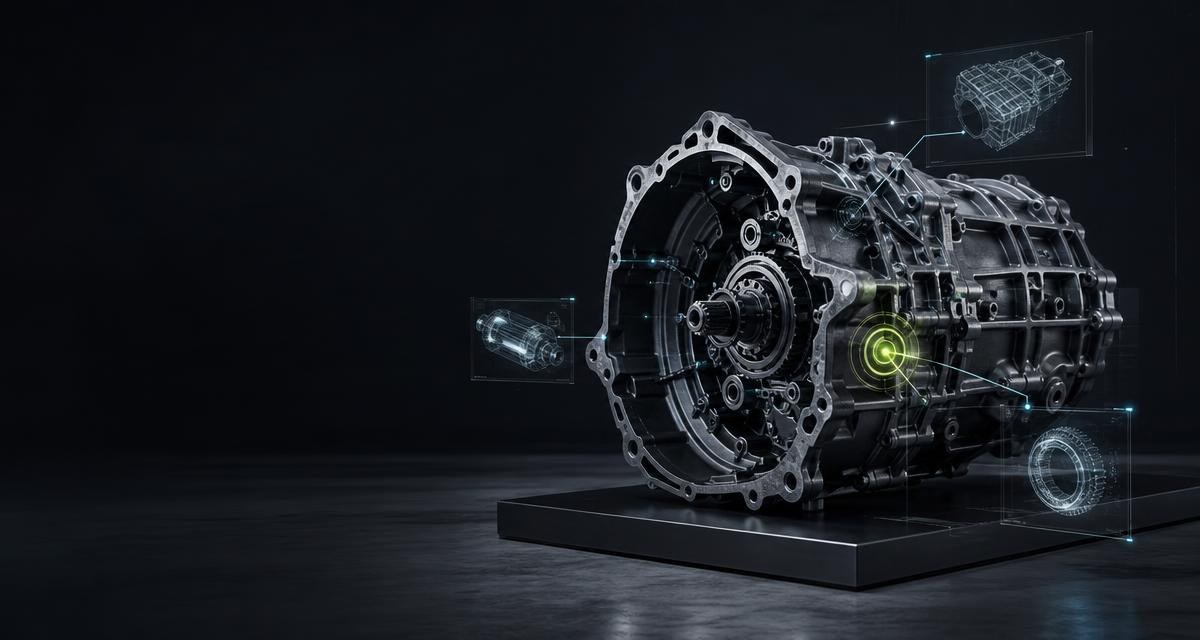
Gearboxes are among the highest-value single components in an end-of-life vehicle — and among those where a return costs most. A returned gearbox means freight both ways, inspection effort, restocking and usually a lost customer.
The code decides, not the model
As with the engine: „six-speed manual, 2.0 diesel“ describes a class. Within one model line several gearbox variants exist with different ratios, different connections and different control. What governs is the gearbox code — a letter block or a type designation depending on the maker — together with the OE number.
- Stamped on the casing or on a label, usually on one of the flange faces.
- On the vehicle data sticker with the vehicle codes — next to the engine code and the paint code.
- In manufacturer data via vehicle identification, that is via the VIN.
What can be checked without fitting
| Check | What it shows | Effort |
|---|---|---|
| Visual check of the casing | Cracks, impact marks, leaks at shaft seals | Low |
| Oil condition and level | Metal debris, burnt smell, oil loss | Low |
| Shifting through the gears by hand | Whether all gears engage and whether it binds | Low, manuals only |
| Play at the driveshaft flanges | Bearing play, differential condition | Medium |
| Donor vehicle mileage | The best available indicator | From the vehicle file |
What cannot be checked is behaviour under load. Claiming otherwise sells an expectation. The honest wording is: „From a vehicle with 96,000 km, externally dry, all gears engage by hand, not tested under load.“ That is precise, verifiable and holds up in a dispute — see Liability for defects on used parts: what applies and what does not.
Automatics and dual clutch
Automated transmissions add a second layer: the control. Control units or mechatronic assemblies are tied to the vehicle and must be adapted or coded after fitting. Without that step the gearbox does not shift cleanly — and the buyer reports a defect where none exists.
Storage and shipping
- Close the openings. An open flange collects dirt and lets oil out.
- Secure the oil level before transporting the gearbox horizontally.
- Store and ship on a pallet. A gearbox in a carton is a damage claim waiting to happen — see Shipping used parts: dimensions, packaging, transport damage.
- State the weight. It determines the freight bracket and belongs in the listing before purchase.
- Name the ancillaries. Whether flywheel, clutch, starter or control unit are included is a statement of its own — and a price component of its own.
What belongs in the listing
Gearbox code, OE number, donor vehicle VIN, mileage, results of the checks performed, note on adaptation, scope of delivery, weight and shipping method. Nine entries — and with them a gearbox is sold to a workshop rather than to someone who phones later. See Workshops as customers: what a trade buyer needs differently.
Frequently asked
Where do I find the gearbox code?
Stamped on the casing or on a label, usually on a flange face, and additionally on the vehicle data sticker with the vehicle codes.
Can I test a removed gearbox?
Externally only: casing, tightness, oil condition, gears by hand. Behaviour under load cannot be established without a vehicle, and that belongs in the listing as such.
Does an automatic gearbox need adapting after fitting?
As a rule yes — adaptation or coding in the vehicle. Without the note in the listing that turns into a complaint.
Are clutch and flywheel included?
Only if you write it. Scope of delivery is one of the most common causes of dispute on gearboxes and belongs explicitly in the description.